मणि-निधि · A treasure of jewels

Every paisa, accounted for.

Monidhi is a private finance journal on the web, with Android and iOS apps coming soon. It reads your bank emails and statements so you don't have to, files them by category, and shows you exactly where your money lives, from SIPs to the family chit fund.

Start free →
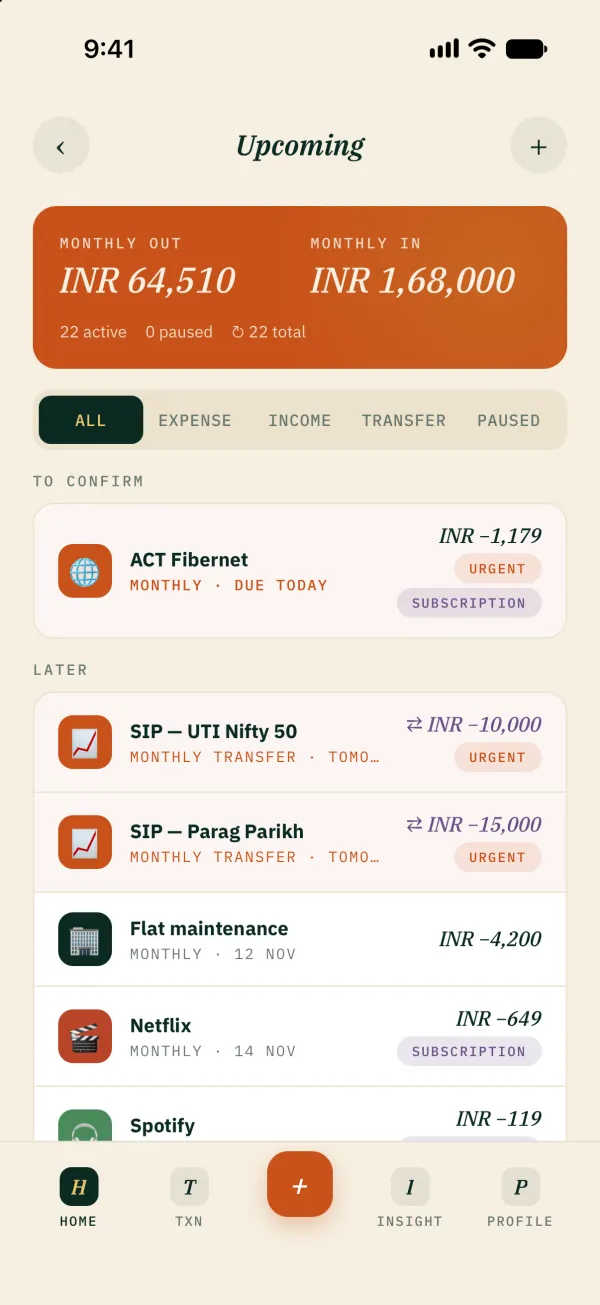
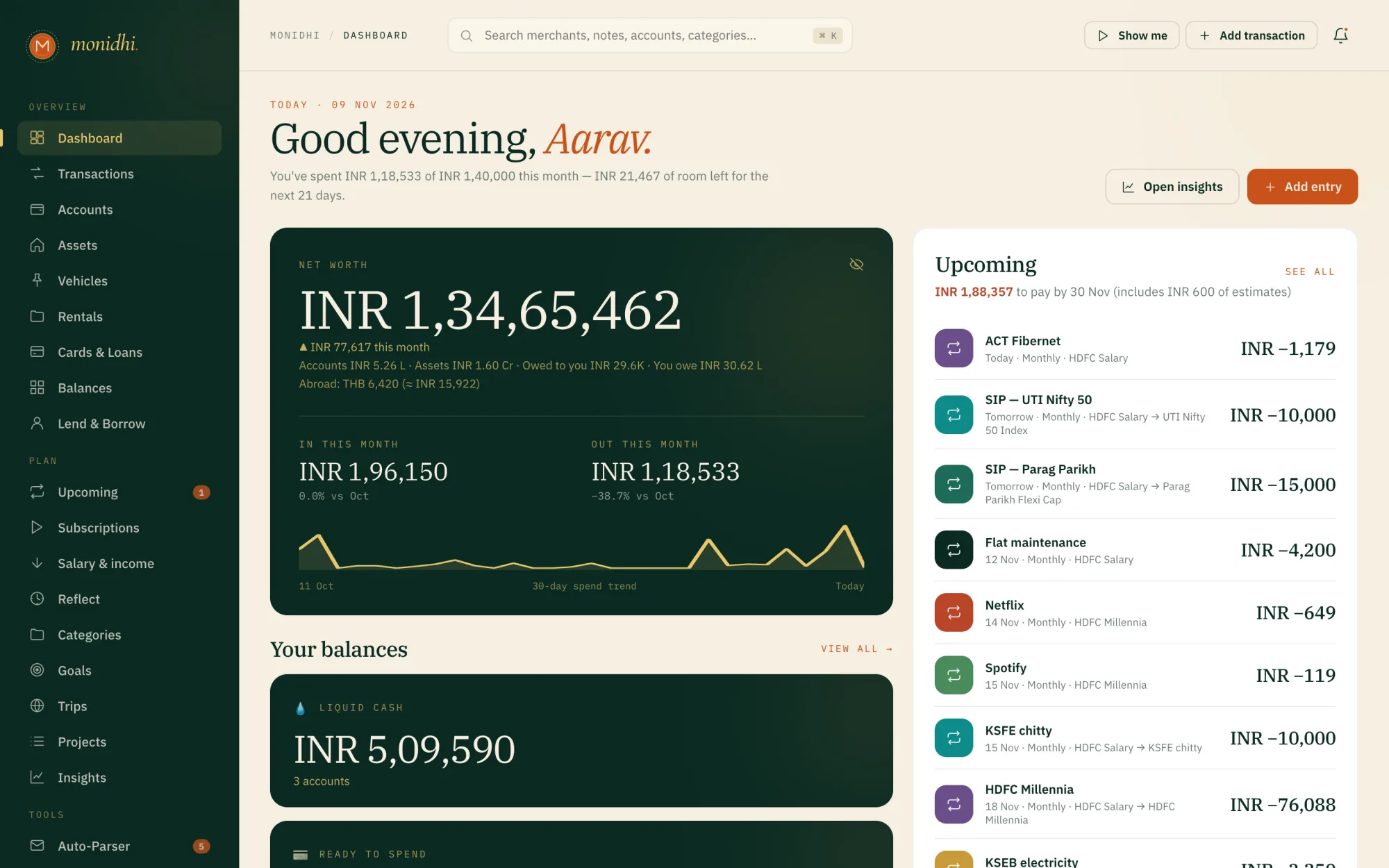
Monidhi dashboard: a net worth of INR 1.35 crore after what is owed, with the eye that hides it, INR 1,96,150 in and INR 1,18,533 out this month, and upcoming payments from a broadband bill to two SIPs.
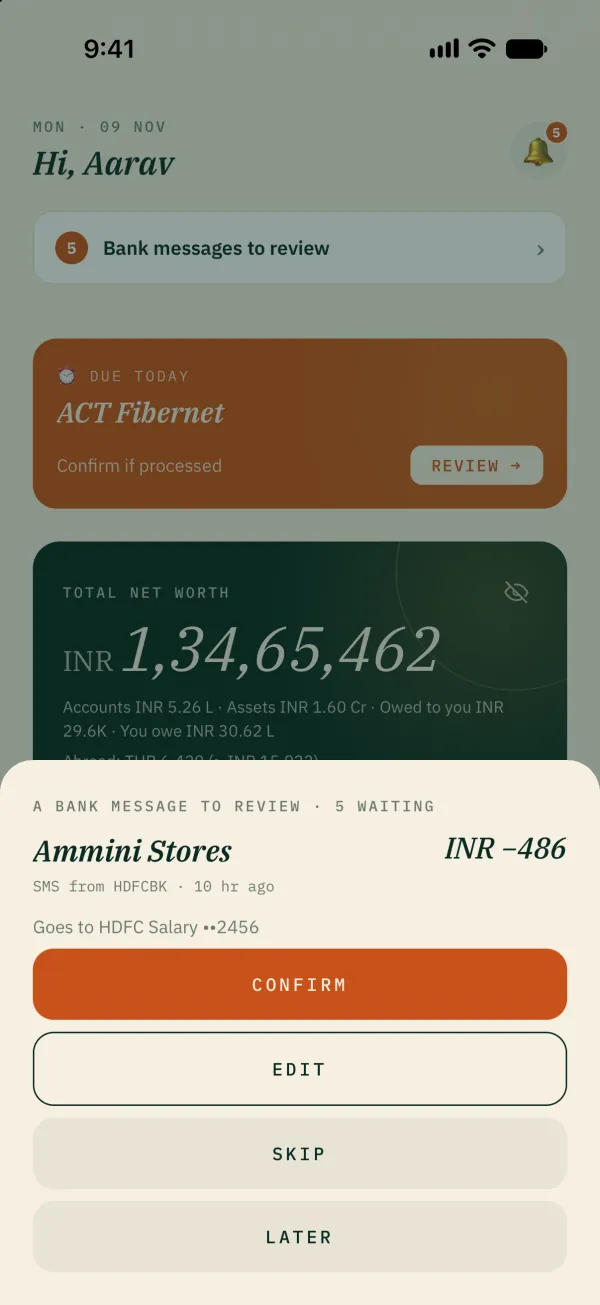
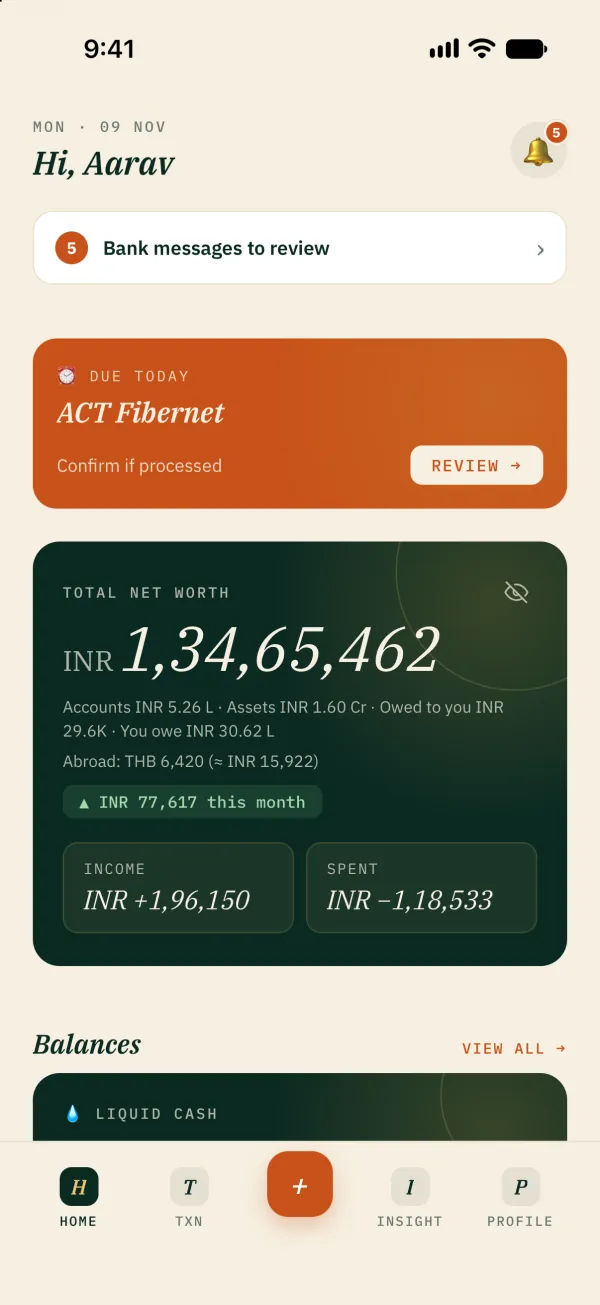
Monidhi's iPhone app on 9 Nov: five bank messages to review, ACT Fibernet due today, and a net worth of INR 1,34,65,462 with this month's income and spending.
Built for the way you actually spend

Quiet tools for loud months.

Monidhi does the bookkeeping so you can focus on the spending — or the saving.

✉

Automatic capture

Bank emails forwarded to your own address, and bank SMS from your phone: With the phone apps, coming soon, Android picks up bank SMS by itself and an iPhone uses a Shortcut. Each becomes an entry you confirm in one tap, or one that files itself on the accounts you choose. Rules rename UPI IDs to the shop, copies are flagged, not counted twice, and a card bill or EMI paid from your bank is suggested as a transfer.

▤

Statements, read for you

A mutual fund CAS, a demat statement, NPS, your EPF passbook, a card or bank statement: upload the PDF or forward the email. Units and card dues update from it, the bank's closing balance shows beside yours, and entries you're missing are picked up. The PDF itself is never kept.

⏱

Upcoming & EMIs

Rent, subscriptions, SIPs, chit instalments, premiums and one-off payments, reminded the day before and on the day. Nothing dated ahead is deducted until you confirm it, and loan EMIs and card bills schedule themselves, each EMI split into interest and principal.

▶

Subscriptions & services

Streaming, the cook, the gym, cloud storage and work tools in one place, with what they cost a month and a year. A fixed price, an estimate, or on demand with a rough next date; payments in your bank messages link themselves.

₹

Salary & payslips

Set up your pay once, new or old regime, and each month's credit is matched to it. Tax, PF and professional tax are booked beside your take-home, so Insights shows your full pay and where it went.

∑

Balances & forecast

Group accounts into balances like "Ready to spend", and see what you'll have left before payday after bills, EMIs, your usual spending and the money you've set aside for goals.

▭

Cards & pay later

Credit cards and pay-later accounts like Simpl, LazyPay or Amazon Pay Later, each with what it owes and its bill scheduled for you. Put a card purchase on EMI and every instalment is booked with its interest, fee and GST. Pay the bill from your bank, typed or from its SMS, and the bill under Upcoming can be marked paid in the same step.

⛟

FASTag & prepaid cards

A reminder to recharge before a FASTag or prepaid card runs low, and an annual pass that counts down its trips from the toll messages themselves.

⇄

Lend & Borrow

Money you lent a friend or borrowed from family, person by person, with a due date and a reminder. It stays out of your income and spending.

÷

Split bills

Split an entry with friends equally, by percentage or by amount, or into parts under other categories. When a friend paid instead, record just your share and what you owe them.

⌖

Goals & budgets

Set a monthly limit per category and see whether you're on pace, with an alert when one runs over. Give each goal a target and a date; what you set aside is held back from what you can spend until you complete it.

✈︎

Trips & currencies

Budget a trip, spend in baht or yen from a forex card, cash or your usual credit card, and see the whole journey in rupees. A card spend abroad keeps "Paid 236 USD" under the rupees it cost.

#

Projects & tags

See what a renovation, a hobby or your car has cost across every category, against a budget if you set one. A home loan's interest and a monthly class can count toward it on their own. Tags label entries more loosely, several to one.

⛽

Fuel & mileage

Log each fill for your car, bike or scooter, or one you rent or borrow, and see the mileage it really gives, full tank to full tank or reserve to reserve, what a kilometre costs, and the price you paid over the year.

↗

Investments

Mutual funds, stocks, NPS, FDs, PPF and the post office schemes, EPF, gold, silver and crypto, valued for you each day, with what you invested kept apart from what it's worth.

◎

Chit funds & pay-in plans

A chit or kuri, a savings club, a jeweller's gold scheme or an RD. Each instalment comes up under Upcoming, the bid you win lands in your bank, and what's still to pay counts in what you owe.

⛉

Insurance

Health, vehicle, term, home and travel cover with its premium and renewal day: a reminder a month ahead, and each premium booked as an expense. Endowment, ULIP and money-back policies count in your net worth.

⌂

Assets

Your home, your car, the family gold — valued by you or estimated for you, and counted in your net worth. So is the rent deposit your landlord holds, until it comes back.

◐

Insights & Plan

Income against spend month by month, where it went by category, your top merchants and a CSV of any range. The Plan sets your usual month against this one and shows where you could save.

◷

Reflect

About to buy something big? Reflect runs the number against your net worth, savings rate, EMI options, goals and what you'll have left before payday — before you tap pay.

⊕

Private by default

Synced across your devices under your account. Balances open hidden until you show them with the eye, and the phone app hides them again when you leave it. Only the parsed fields of a bank message or a statement are kept, and we never sell your data.
Inside the app

A finance journal, not a dashboard.

Real screens, real numbers, real rhythm — pulled straight from Monidhi on desktop and on your phone.

Income vs spend
A clear story, month by month
Year view
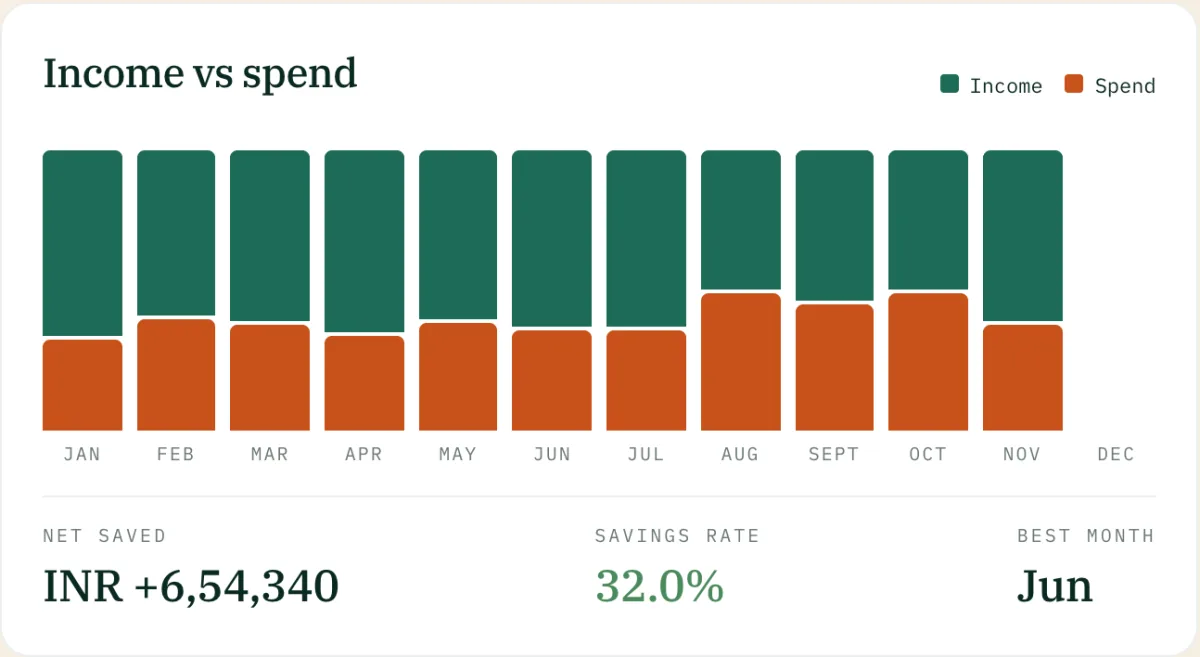
Income against spend for each month of 2026, with INR 6,54,340 saved and a 32% savings rate.
Categories · November
Where it went
6 categories
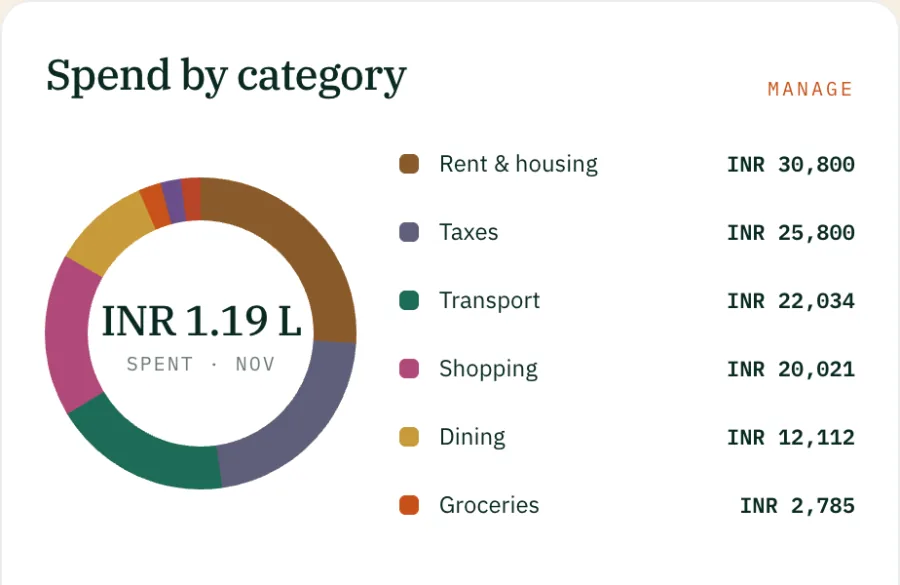
Spend by category for November: housing, taxes, transport, shopping, dining and groceries, INR 1.19 lakh in all.
On your phone
Mornings, ten seconds
A bank message to review on iPhone: INR 486 at Ammini Stores from an HDFC Bank SMS, going to HDFC Salary, with Confirm, Edit, Skip and Later.
Goals
Quiet, patient progress
4 active
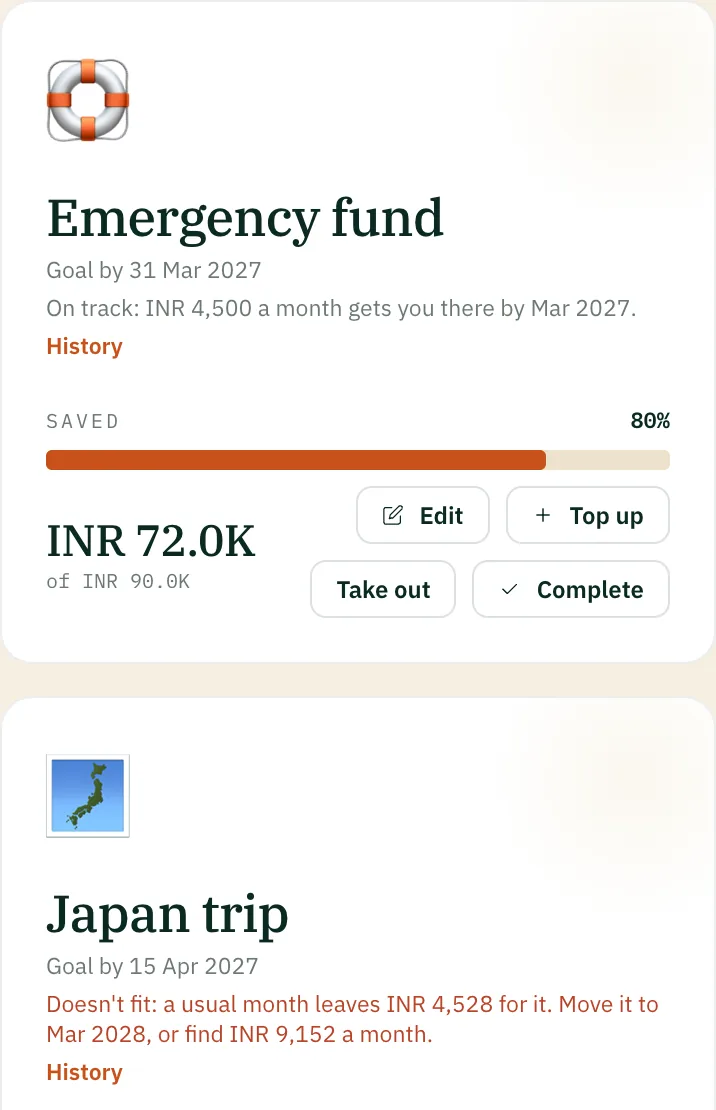
Goals: an emergency fund 80% saved and on track for 31 March 2027, and a Japan trip that a usual month can't fund by 15 April 2027, with what it would take.
Upcoming · due soon
What's due
4 to confirm
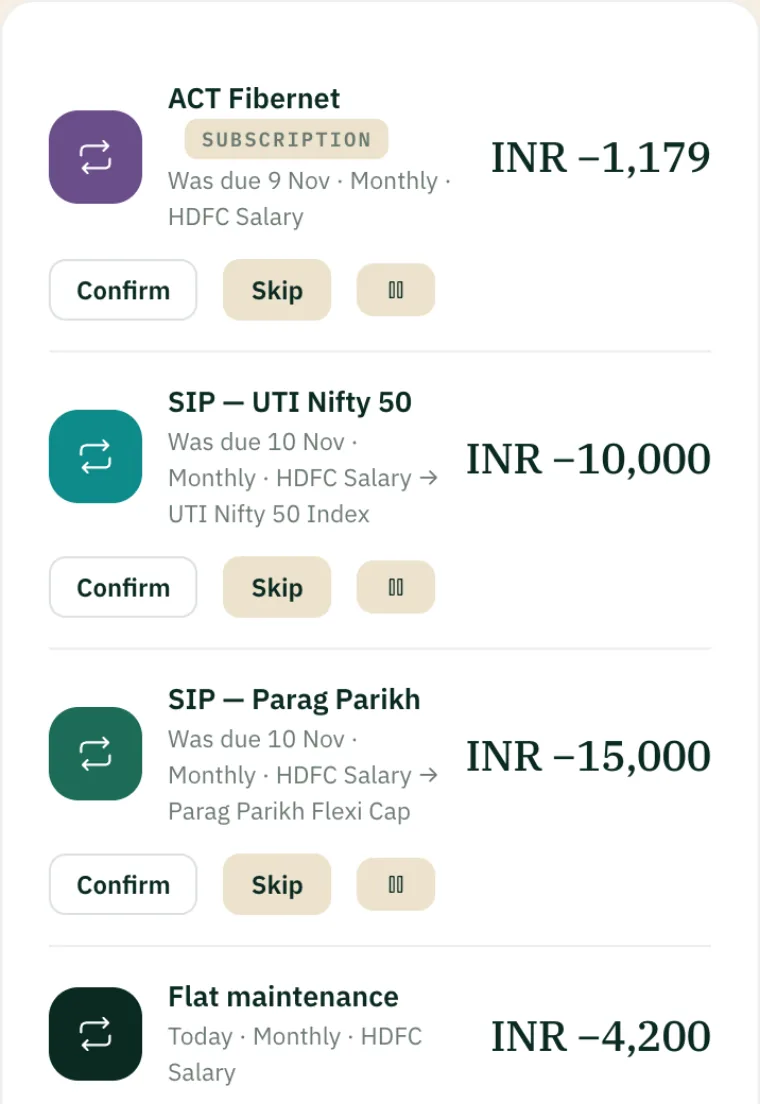
To confirm: an ACT Fibernet subscription due 9 Nov, two SIPs due 10 Nov and flat maintenance due today, each with Confirm and Skip.
On your phone

The same journal, in your pocket.

The iPhone and Android apps are coming soon, kept in sync with the web. Android reads bank SMS by itself and an iPhone uses a Shortcut, so the messages reach the journal wherever you are. These are screens from the iPhone app.

New · Automatic capture

Bank messages, filed for you.

Every card swipe and UPI payment already sends you an SMS or an email, and every month brings a statement. Monidhi reads them, names the merchant, picks the category and waits for your one-tap confirm, or, for the accounts you choose, files them itself and lets you undo any. The message text and the PDF are never kept.

  • Three ways inBank emails go to your own forwarding address. With the phone apps, coming soon, Android picks up bank SMS by itself and an iPhone uses a Shortcut. Only bank-looking messages leave your phone, never one-time passwords.
  • Rules that learn your shopsA UPI ID becomes the shop's name and lands in the right category, every time it comes back.
  • Copies caughtWhen the SMS and the email for one payment both arrive, Monidhi flags the pair and lets you keep one.
  • Statements tooUpload a statement PDF or forward the email: a mutual fund CAS, a demat statement, NPS, an EPF passbook, a card or bank statement. The first asks where each holding or account goes, and later ones follow it. Save a password once and the next statement opens by itself.
  • Card bills and EMIs, as transfersA card's “payment received”, a debit that names your card, or a loan's EMI leaving its account is suggested as a transfer, neither spending nor income, and always waits for you. Confirming it can mark the bill or EMI under Upcoming paid, and the other bank's message for the same payment shows as its copy.
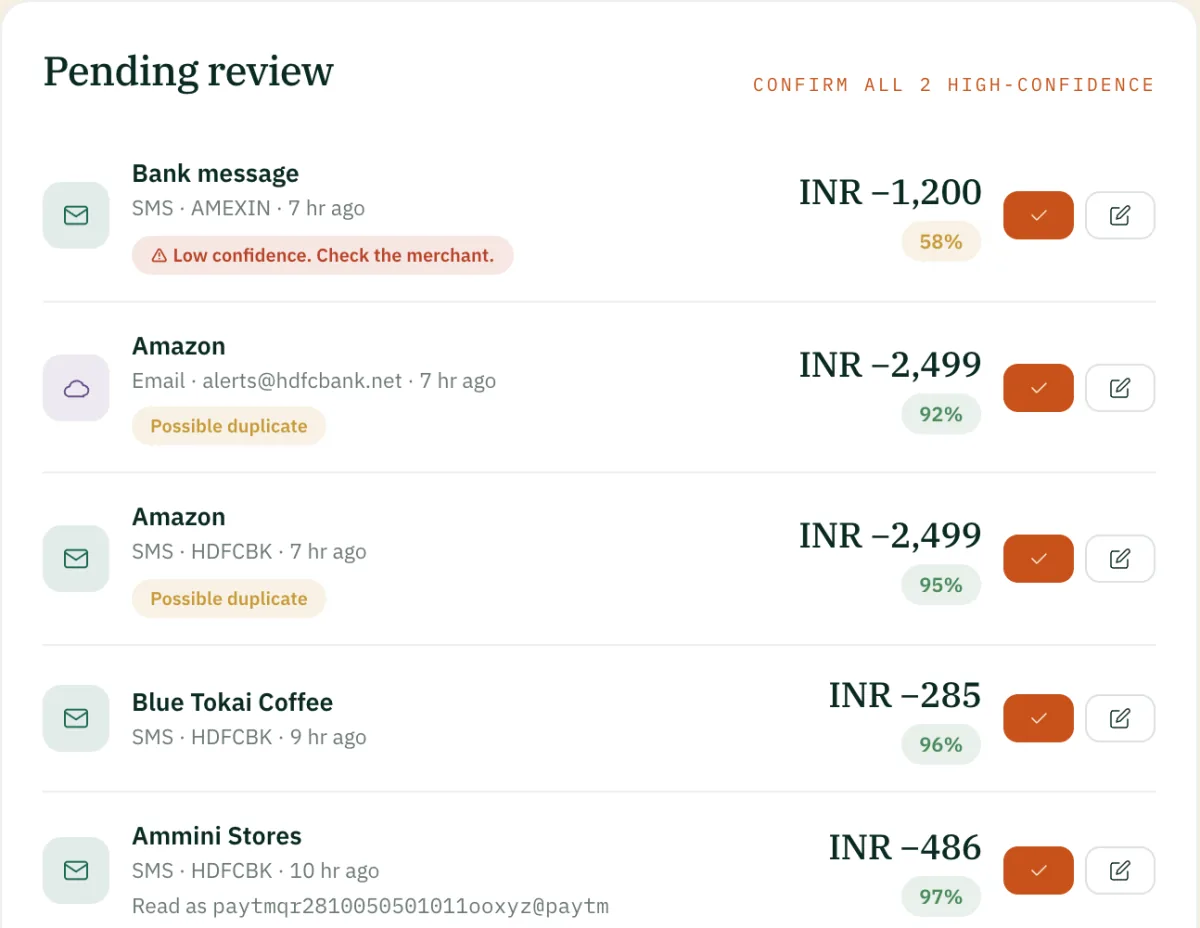
Bank messages waiting for review: a low-confidence card message to check, an Amazon payment flagged as a possible duplicate across email and SMS, and a UPI ID renamed to Ammini Stores by a merchant rule.
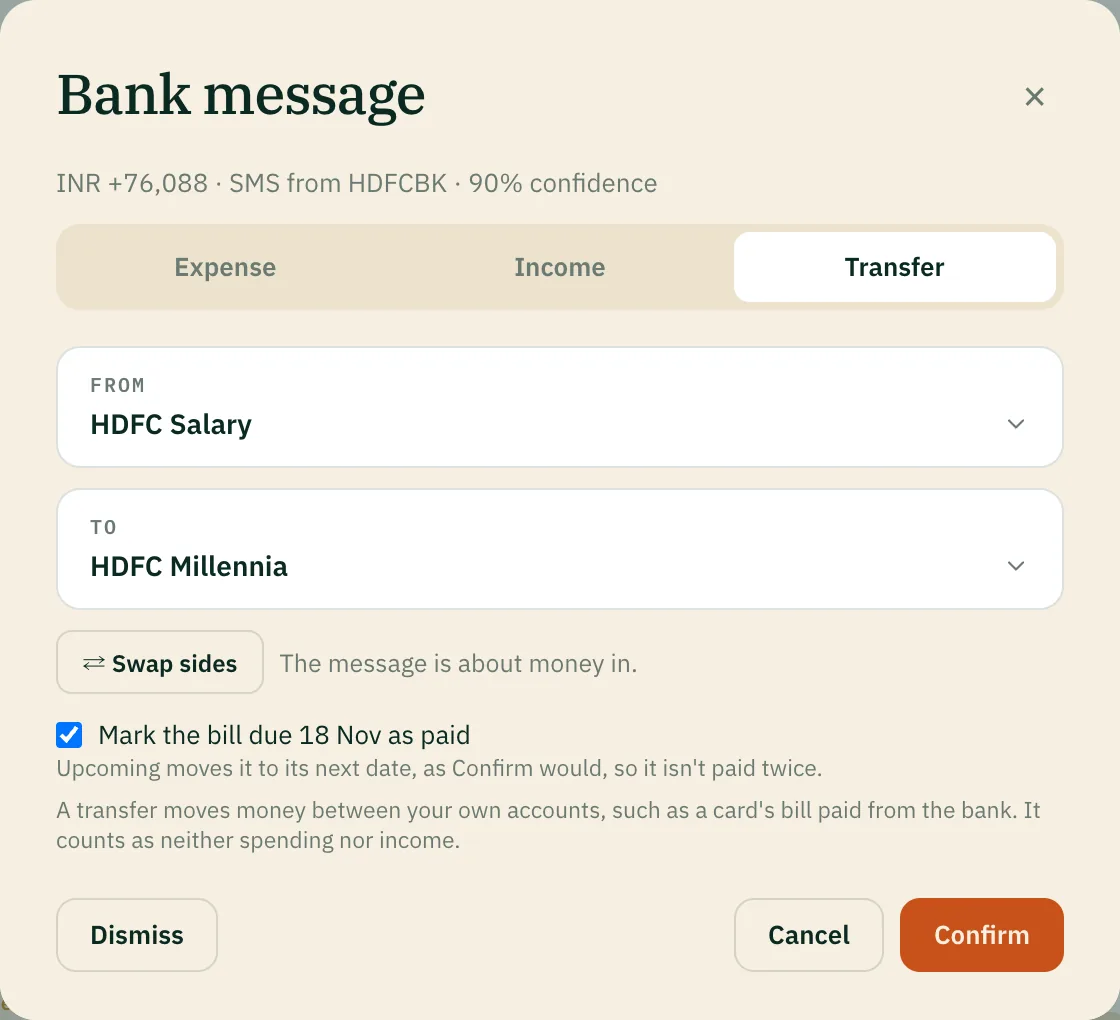
A card's “payment received” SMS reviewed as a transfer: INR 76,088 from HDFC Salary to the HDFC Millennia card, with Mark the bill due 18 Nov as paid ticked.
New · Plan

This month, thought through.

Insights now has a Plan. It works out your usual month from your own entries, sets this one against it, and shows what's different, where you could save and how the next few months end, with how sure each estimate is.

  • Your usual monthThe last three months of entries give a usual month, split into needs and wants, set against what this month looks like, with how sure the estimate is.
  • What's different this timeTrip payments still to come and one-off spends are called out, and yearly bills are added up into what to put aside each month.
  • Where you could saveWait a month on a wishlist buy, postpone a trip payment, pause shopping or collect what a friend owes. Pick the cuts yourself, or let Plan for me pick enough to cover a shortfall. Say you want to keep one and it isn't suggested again for three months.
  • The months aheadWhere your accounts end each month, what's free after goals and the lowest point. If a month runs short, money you could move is listed from free to costly, and borrowing is never suggested.
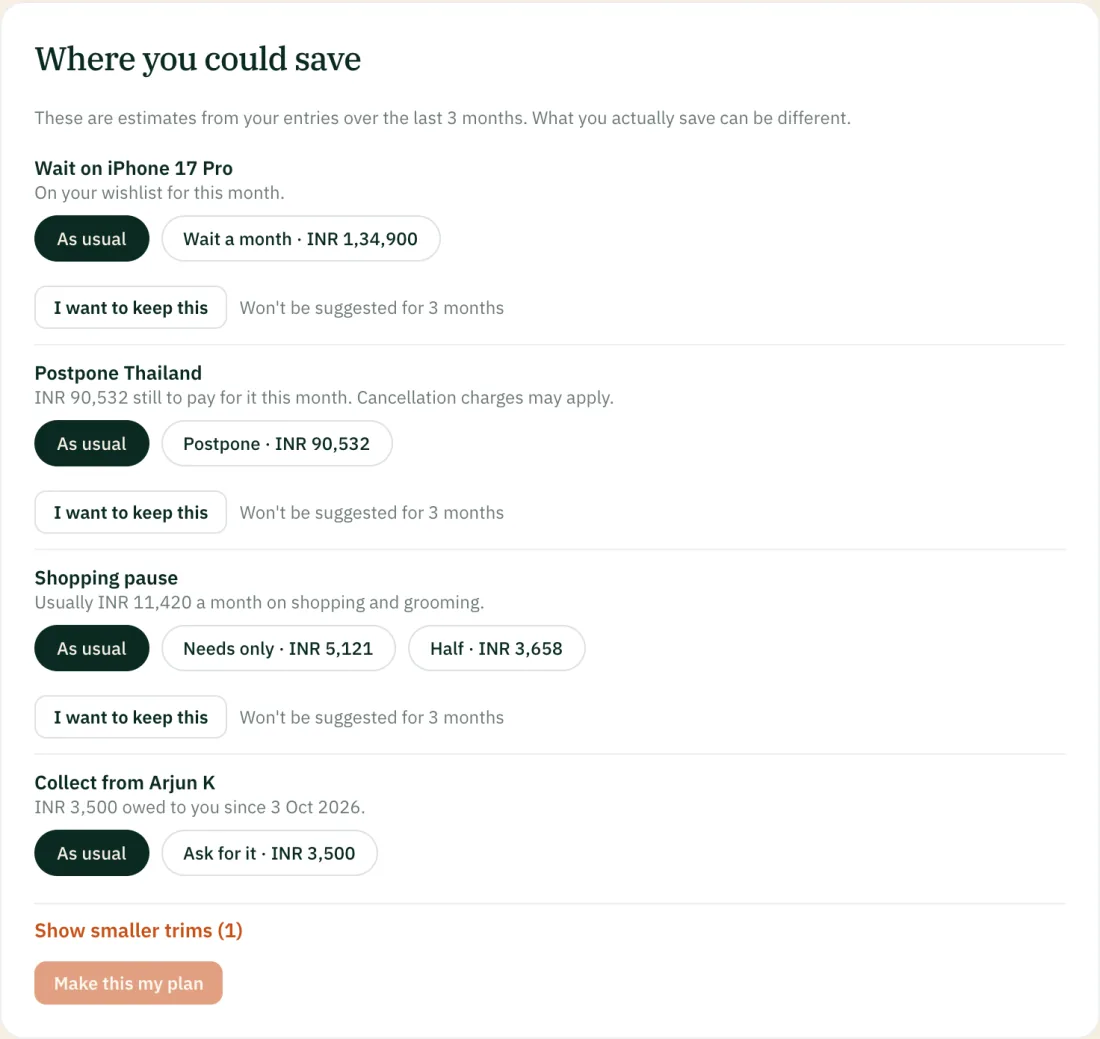
Where you could save this month: wait a month on an iPhone 17 Pro from the wishlist, postpone the INR 90,532 still to pay for the Thailand trip, pause shopping, or ask Arjun K for the INR 3,500 owed since 3 Oct 2026.
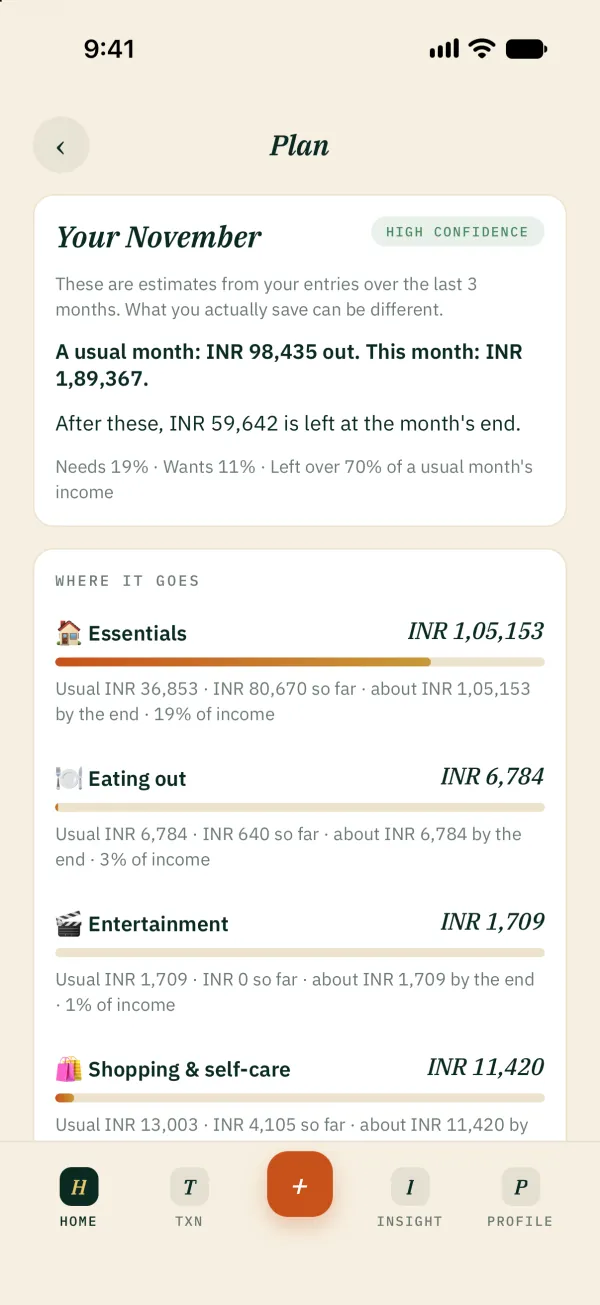
The Plan on iPhone: a usual month of INR 98,435 out against INR 1,89,367 this month, INR 59,642 left at the month's end, and where it goes by group.
New · Balances & forecast

Know what's left before payday.

Group your money the way you think about it, and see what you'll have on the day before your salary lands.

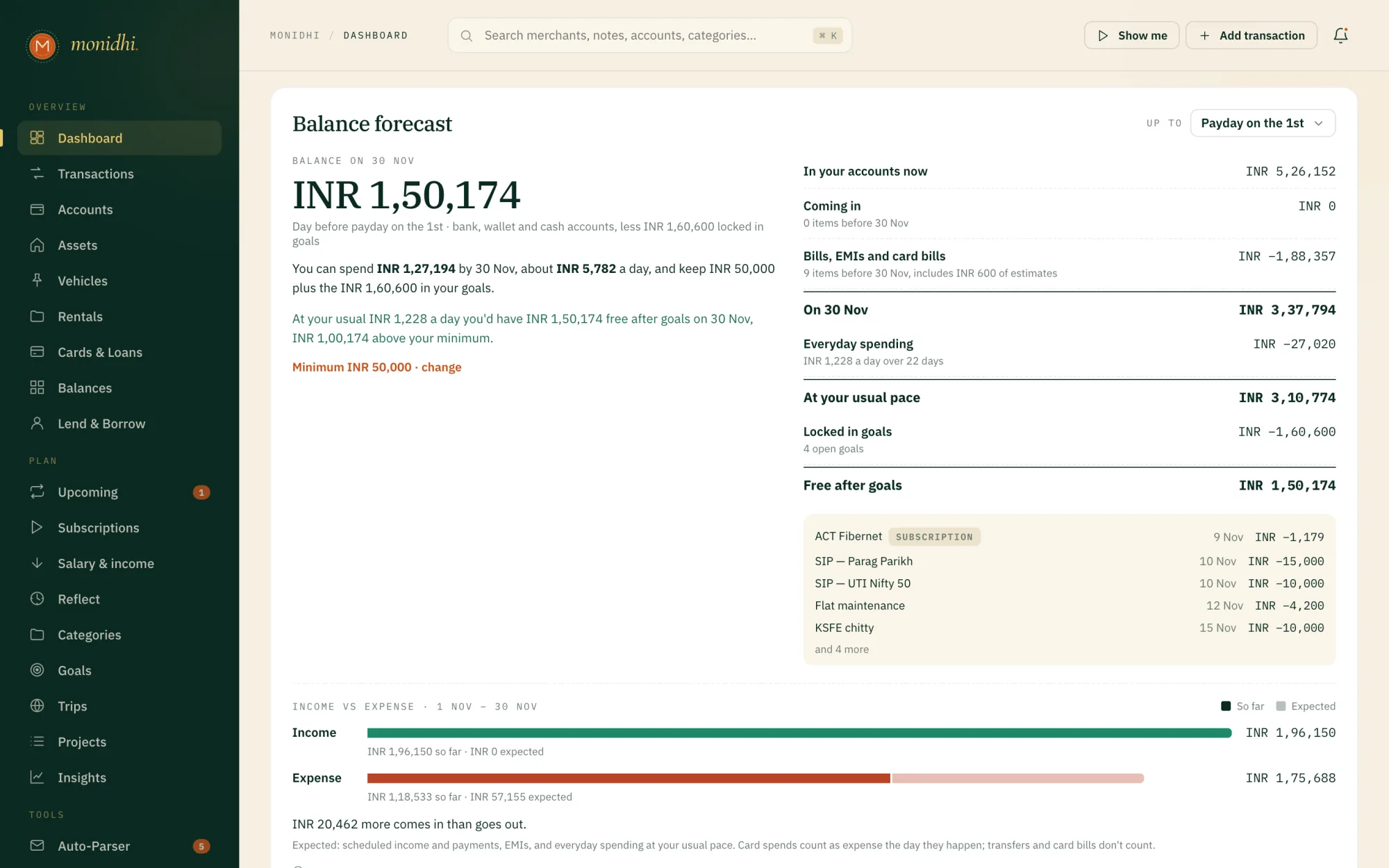
Balance forecast: INR 1,50,174 on 30 November after bills, EMIs, usual spending and the INR 1,60,600 kept in goals, with INR 1,27,194 to spend while keeping INR 50,000.

Balances your way

Liquid cash, ready to spend, home equity: pick the accounts, cards and loans behind each figure, and pin the ones you check most.

Up to payday

Bills, EMIs, card bills and your usual daily spending come off what's in your accounts, up to the day before your salary lands.

Keep a minimum

Set the least you want left, and see how much you can spend each day and still keep it. Money you've set aside for goals is held back too, until you complete them.

New · Subscriptions & services

Everything you pay for, again and again.

Streaming, the cook, the gym, cloud storage, the tools you work with: each in one place with what it costs a month and a year. Confirm or Skip comes up the day before a payment is due, and every payment stays a single entry.

  • Fixed, estimated or on demandA fixed price, an estimate for one that varies like the cook's pay, or no cycle at all for the salon, with a rough next date that still counts in your forecast.
  • Found in your bank messagesNetflix, Spotify, ACT Fibernet and other known providers are recognised in card and bank alerts, so a payment links itself to its subscription. One that nearly fits is asked about.
  • Prices change, history staysConfirm at a new price and it's kept from then on, with the change on record. Pause, end or restart one and its past payments stay where they are.
  • Advances and depositsAn advance paid to the cook or a deposit with a service sits under Deposits paid until it's used up or comes back.
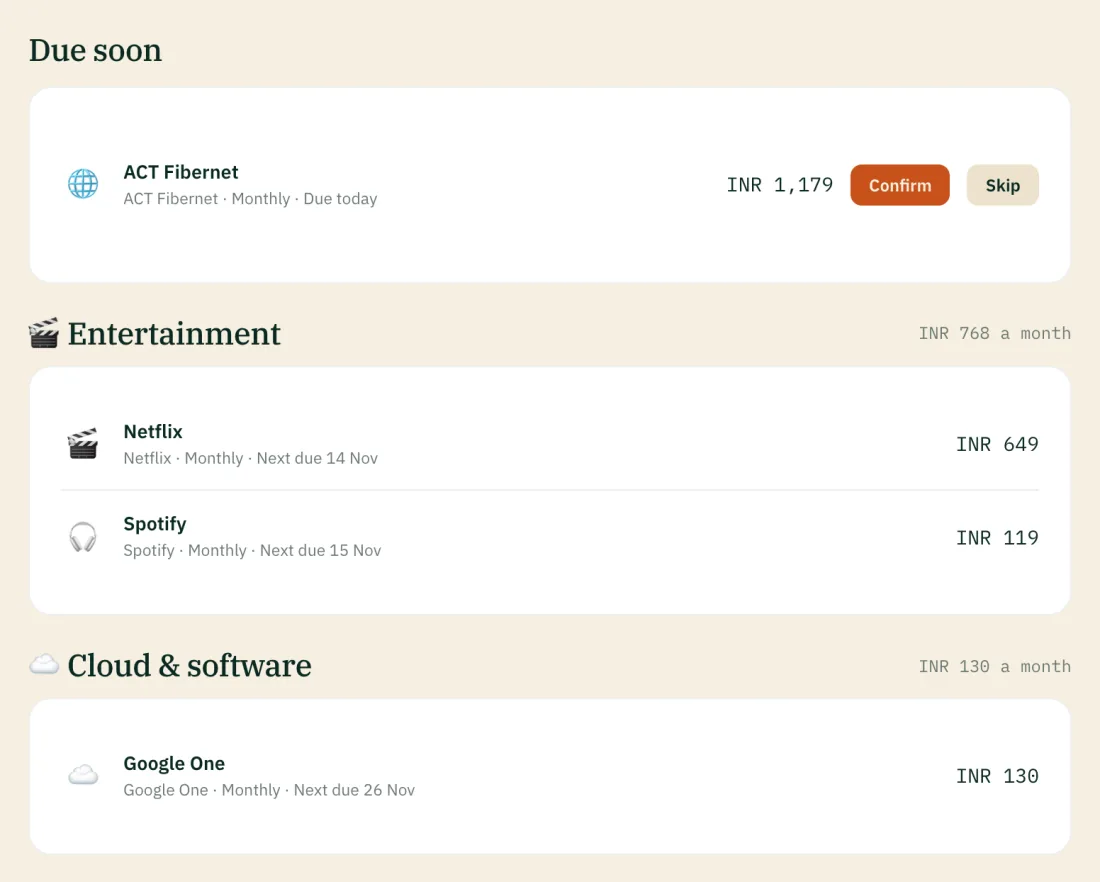
Subscriptions due soon: ACT Fibernet at INR 1,179 due today with Confirm and Skip, while Netflix (14 Nov), Spotify (15 Nov) and Google One (26 Nov) wait in their groups with their next dates.
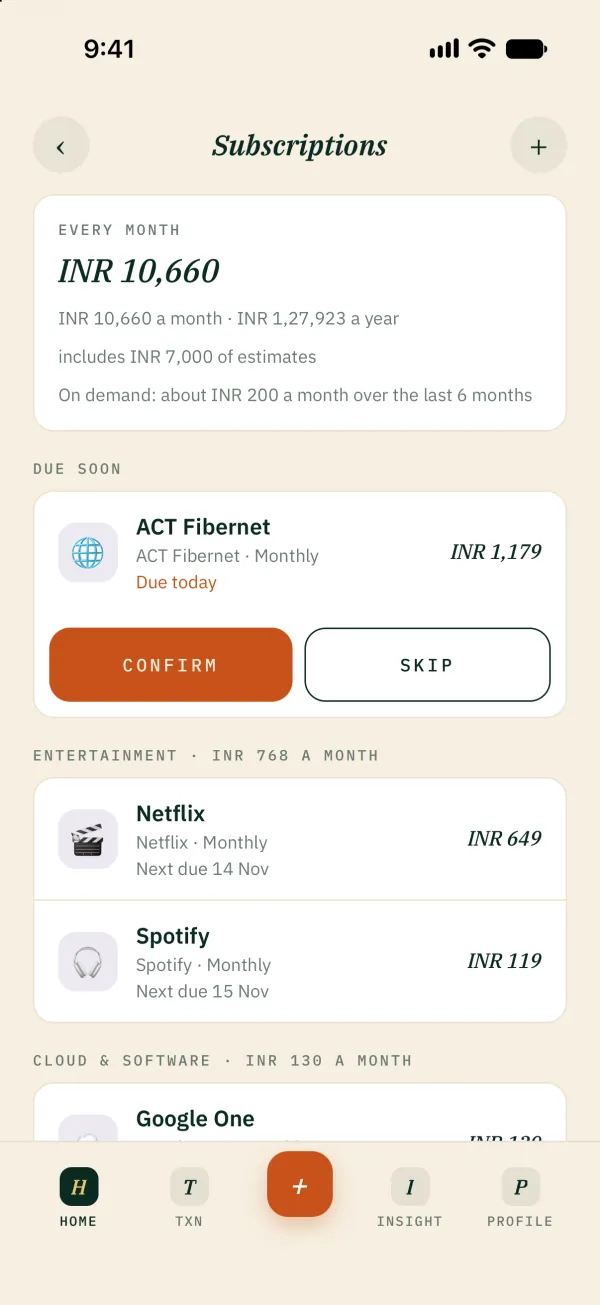
Subscriptions on iPhone: INR 10,660 a month and INR 1,27,923 a year, with ACT Fibernet due today to confirm or skip, and Netflix and Spotify waiting with their next dates.
New · Salary & payslips

Your whole pay, not just take-home.

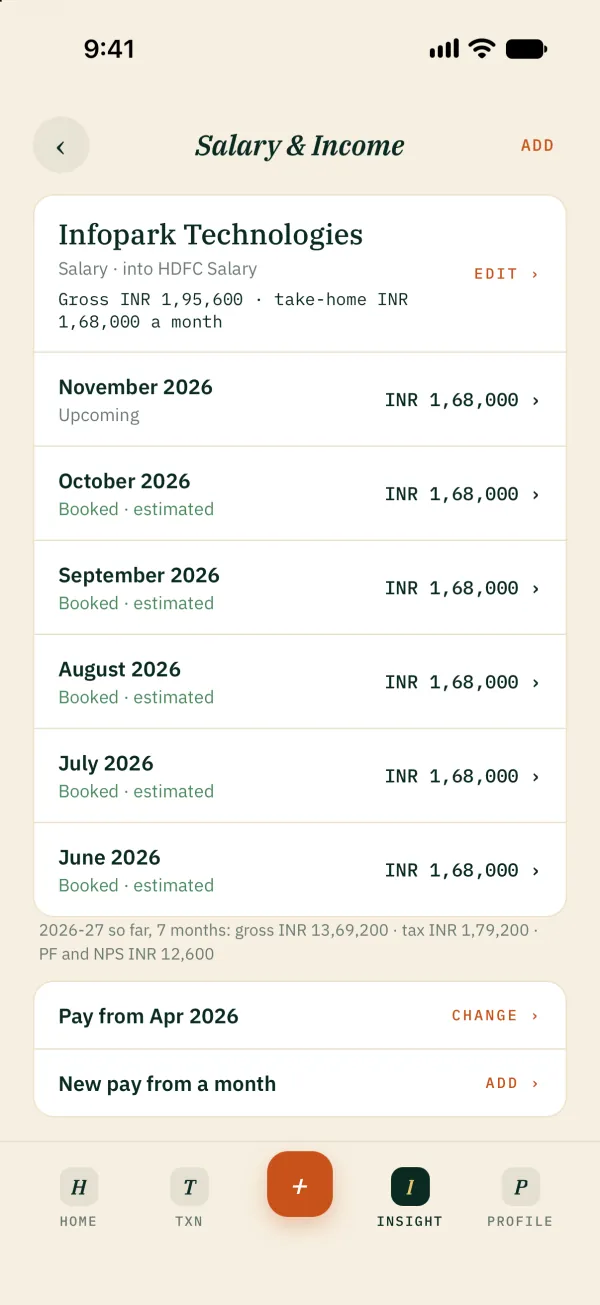
Your bank only sees what's left after tax and PF. Tell Monidhi your salary once and each month's credit is matched to it, with the tax, PF and the rest booked beside it.

  • Set up onceBasic, HRA, allowances, PF, tax and your employer's share, under the new or old regime, from the month it starts. Professional or contract fees work too.
  • Matched as it landsWhen a credit matches your take-home, that month's payslip is booked for you and marked estimated until you check it against the real one.
  • Your take-home stays as the bank shows itTax and professional tax are booked beside it as spending under Taxes, and PF goes into your EPF, so a year shows gross pay, tax paid and what you put away.
  • A different monthA bonus or a tax change: edit that month's payslip and only its rows change, with a note of which line changed and how.
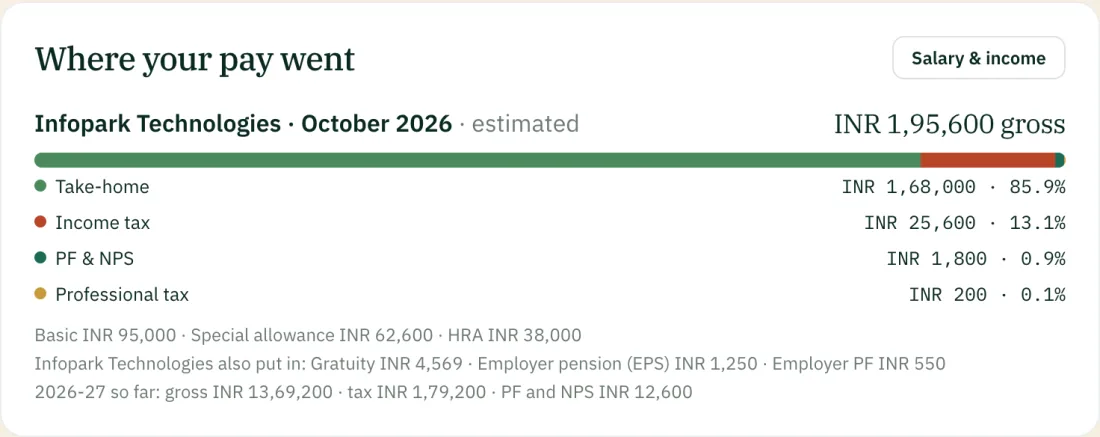
Where October's pay went: INR 1,95,600 gross, of which INR 1,68,000 reached the bank, INR 25,600 went in income tax, INR 1,800 into PF and INR 200 in professional tax.
Salary & Income on iPhone: Infopark Technologies, INR 1,95,600 gross and INR 1,68,000 take-home a month, with each month's payslip.
Loans

Every EMI, split into interest and principal.

A payment to a loan isn't one number. Monidhi splits each payment and each EMI into interest and principal: the interest goes down as spending, and only the principal comes off what you owe.

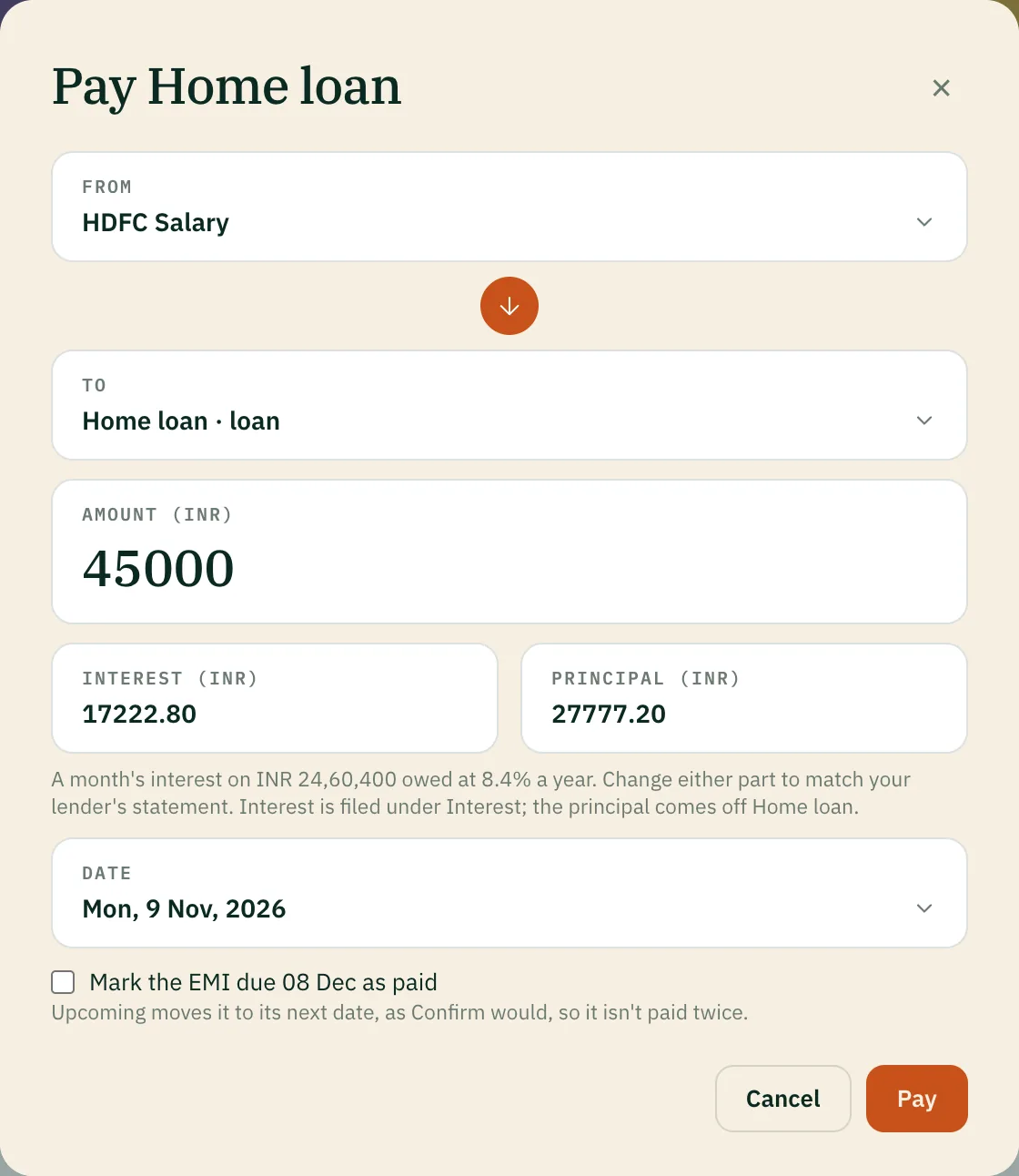
  • Split for youPay a loan or confirm its EMI and Monidhi works out a month's interest on what you owe, at the loan's rate. The rest is principal.
  • Interest counts as spendingThe interest is filed under Interest, so it shows in your spending, insights and exports. Only the principal brings the loan down.
  • Match your statementIf the bank's figure is different, change the interest or the principal before you log it, or edit the entry later. The other part follows.
  • Marked paid as you payPay a loan, or confirm the EMI from your bank's SMS, and the EMI waiting under Upcoming can be marked paid at the same time. An EMI-sized debit from the loan's account near its date is suggested as that loan.
Paying INR 45,000 from HDFC Salary to a home loan: INR 17,222.80 interest, a month's interest on INR 24,60,400 owed at 8.4% a year, and INR 27,777.20 principal, either part editable, and a box to mark the EMI due 8 Dec as paid.
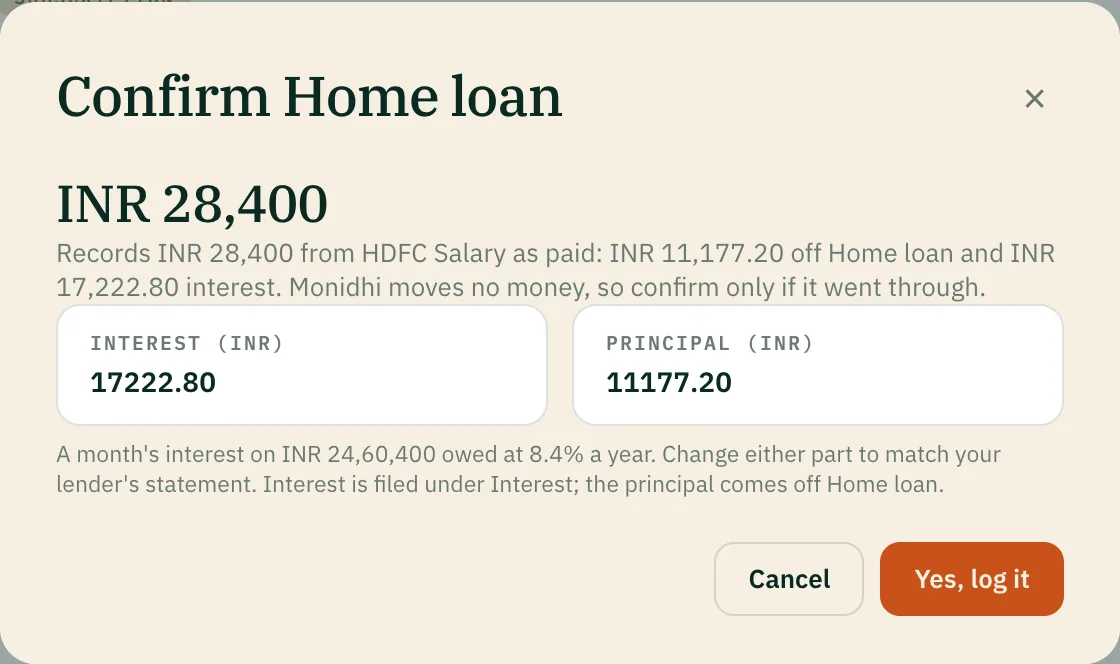
Confirming a INR 28,400 home loan EMI: INR 11,177.20 off the loan and INR 17,222.80 interest, with both parts editable before it is logged.
New · Lend & Borrow

Money between friends, kept straight.

The deposit a friend still owes, the concert tickets your sister covered. Note who gave what, and Monidhi keeps the running balance with each person. Add their email to invite them, and once they join you'll see the name they use.

  • Who owes whomMoney you lent and money you borrowed, person by person, with what's owed to you and what you owe at a glance.
  • Due dates, rememberedGive a balance a date and Monidhi reminds you the day before and on the day.
  • Not your spendingThese entries move your accounts but never count as income or spending. Money you won't see again can be marked as not expected back.
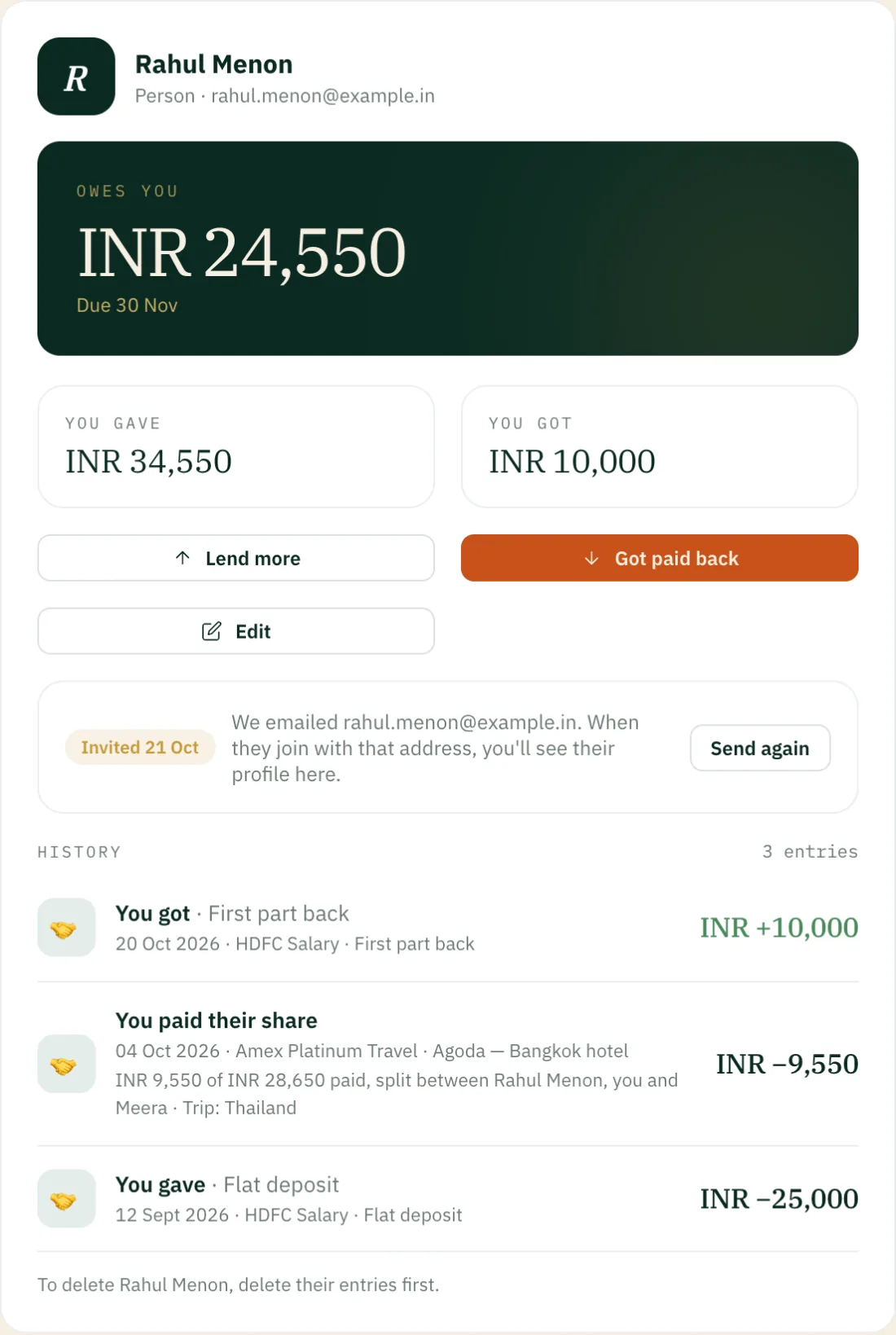
Rahul Menon owes INR 24,550, due 30 November: INR 34,550 given, including a share of a hotel on the Thailand trip, and INR 10,000 got back, with an invitation sent to the email address on file.
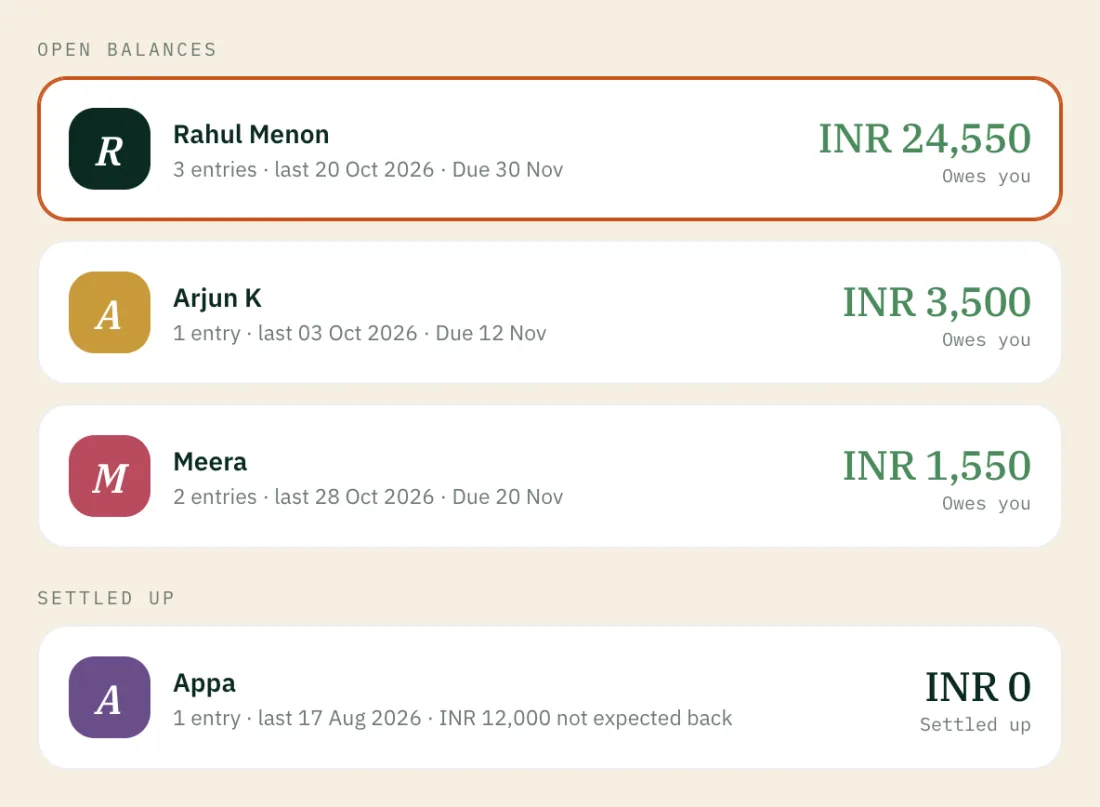
Open balances: Rahul Menon owes INR 24,550, Arjun K owes INR 3,500, Meera owes INR 1,550, and Appa is settled up.
New · Split

One bill, everyone's share.

You paid for the hotel, and three of you stayed. Split the entry and Monidhi keeps your share as your spending and files the rest under each friend in Lend & Borrow, without moving a rupee in your account.

  • With friends, or into partsShare an entry equally, by percentage or by amount, and you are always one of the people. Or cut part of it off under another category. The pieces stay linked, and any one can be put back.
  • Each share where it belongsA friend's share goes to their balance in Lend & Borrow and out of your spending. One you don't expect back can be marked so, and it stays off what they owe.
  • When someone else paidEnter the whole bill, who paid and who shared it. Your share counts as your spending and as money you owe them, and nothing leaves your accounts.
  • Friends on Monidhi hear about itIf a friend's email is on a Monidhi account, they get a notice with their share and can add it to their own journal, link an entry they already have, or ignore it.
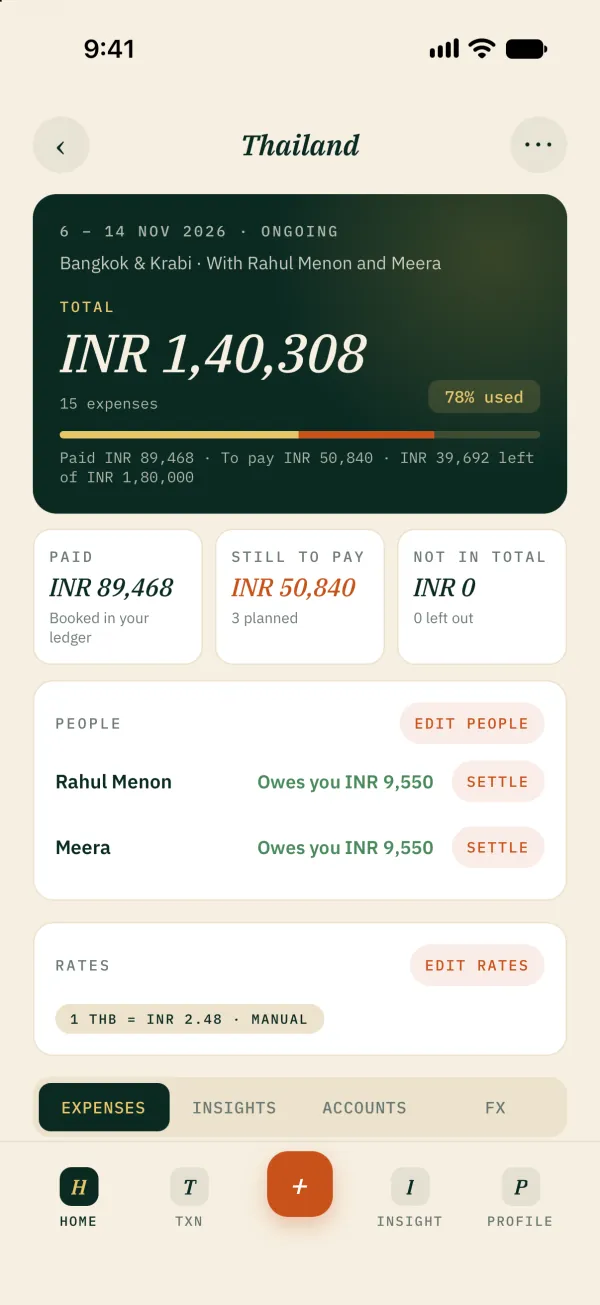
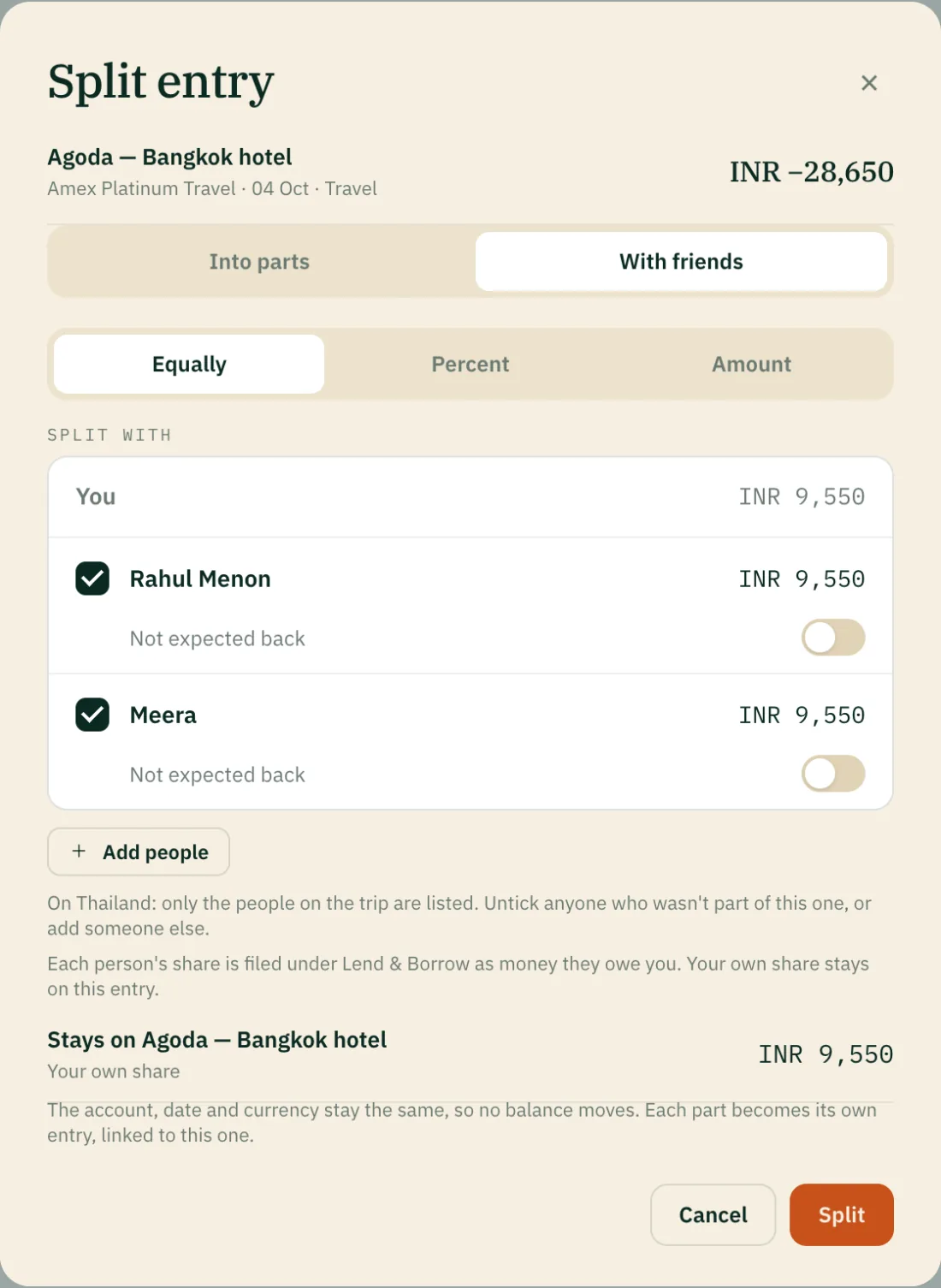
Splitting a INR 28,650 hotel booking equally with Rahul Menon and Meera on the Thailand trip: INR 9,550 each, with a switch to mark a share as not expected back.
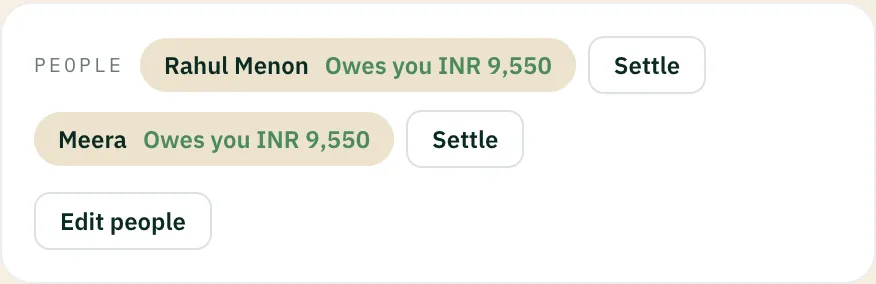
The people on the Thailand trip after the split: Rahul Menon owes you INR 9,550 and Meera owes you INR 9,550.
Trips

Journeys, accounted for.

Plan what a trip will cost, pay in any currency, and see what it really came to in rupees.

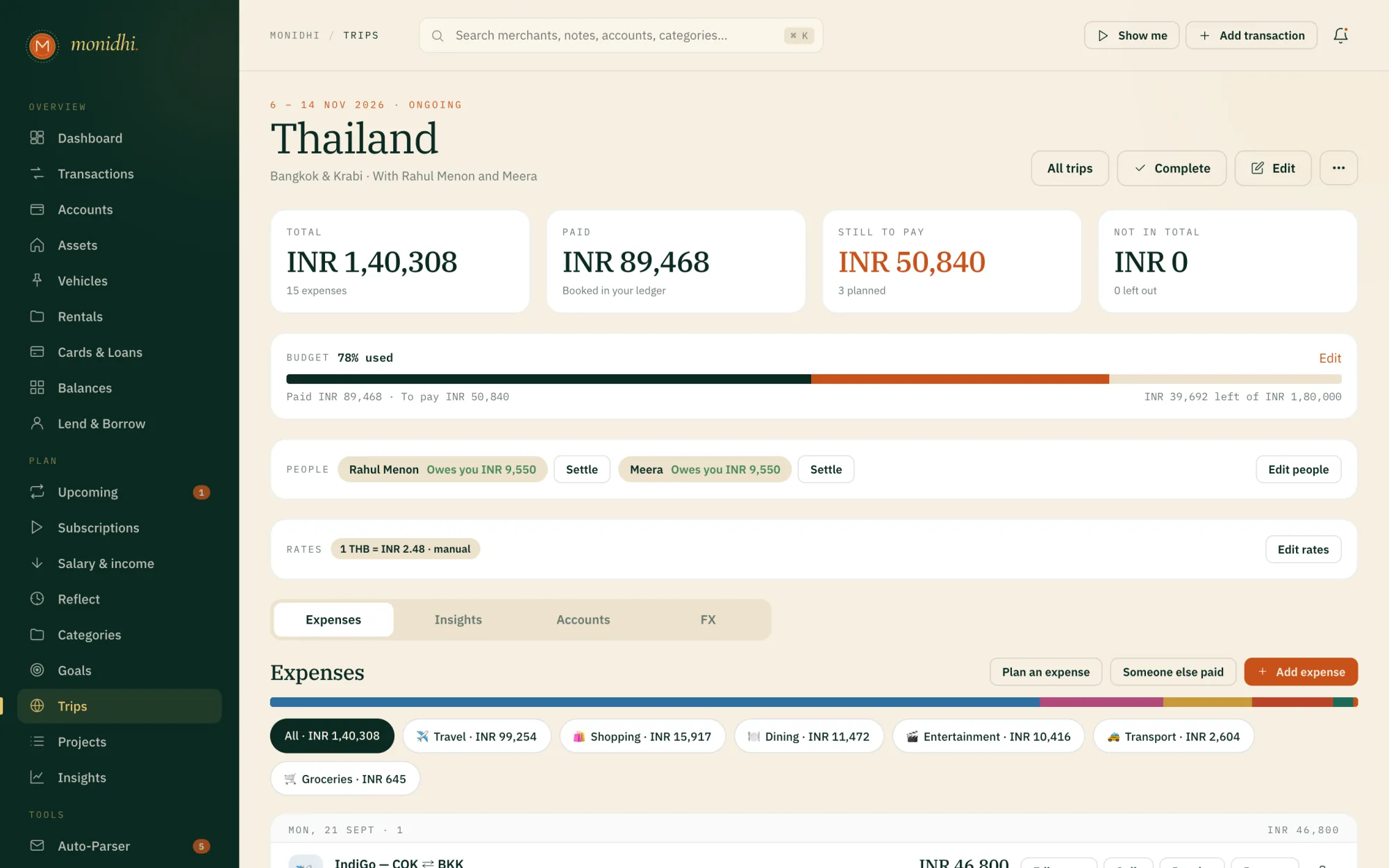
A Thailand trip in Monidhi with Rahul Menon and Meera: INR 1,40,308 in all, INR 50,840 still to pay, 78% of the budget used, and each friend owing INR 9,550 for the trip.

Plan before you go

Set a budget and add the bookings you know are coming. Paid and still-to-pay add up against it as the trip happens.

Spend in any currency

A wallet of baht or a forex card is priced at the trip's rate. Pay on your usual credit card and the entry keeps what you paid in baht under the rupees, at the day's rate plus your card's markup until you have the bank's figure.

One total, in rupees

Flights booked weeks ago, card swipes and street-food cash all land on the same trip. Its Insights show a ring of what went on each category and a bar for every day, paid and still to pay.

Travelling with friends

Add who came, and splitting any expense of the trip starts with them, shared equally. The trip's total counts only your own share, and it shows what each person still owes you for it.

New · Fuel, mileage & FASTag

What a kilometre really costs.

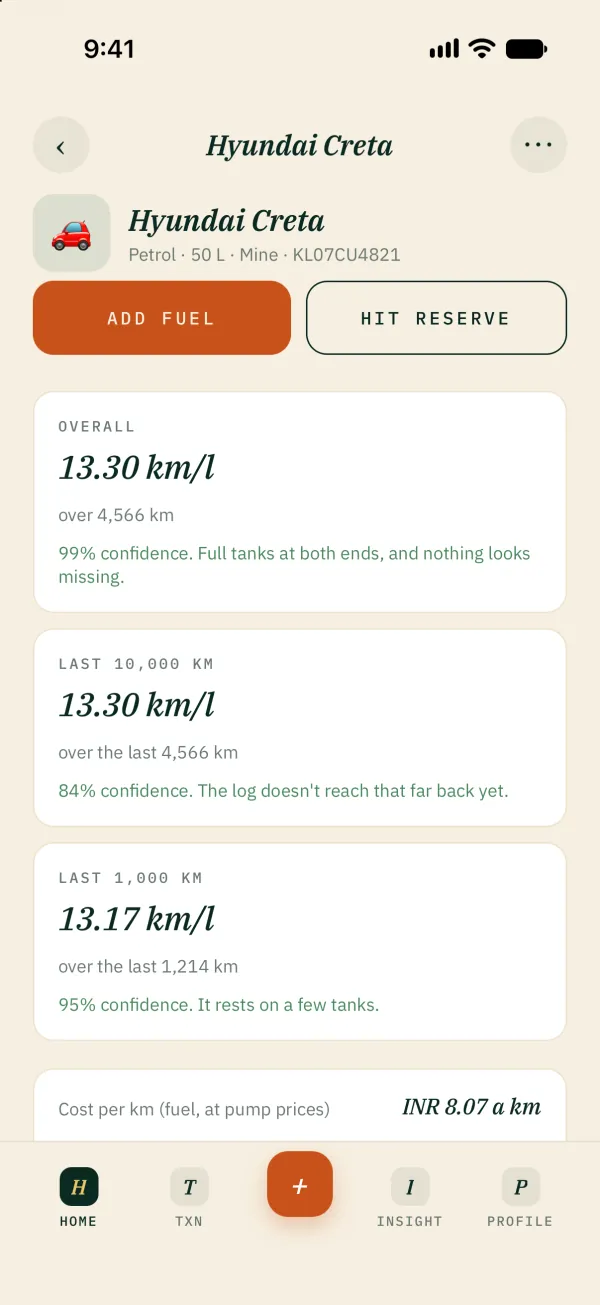
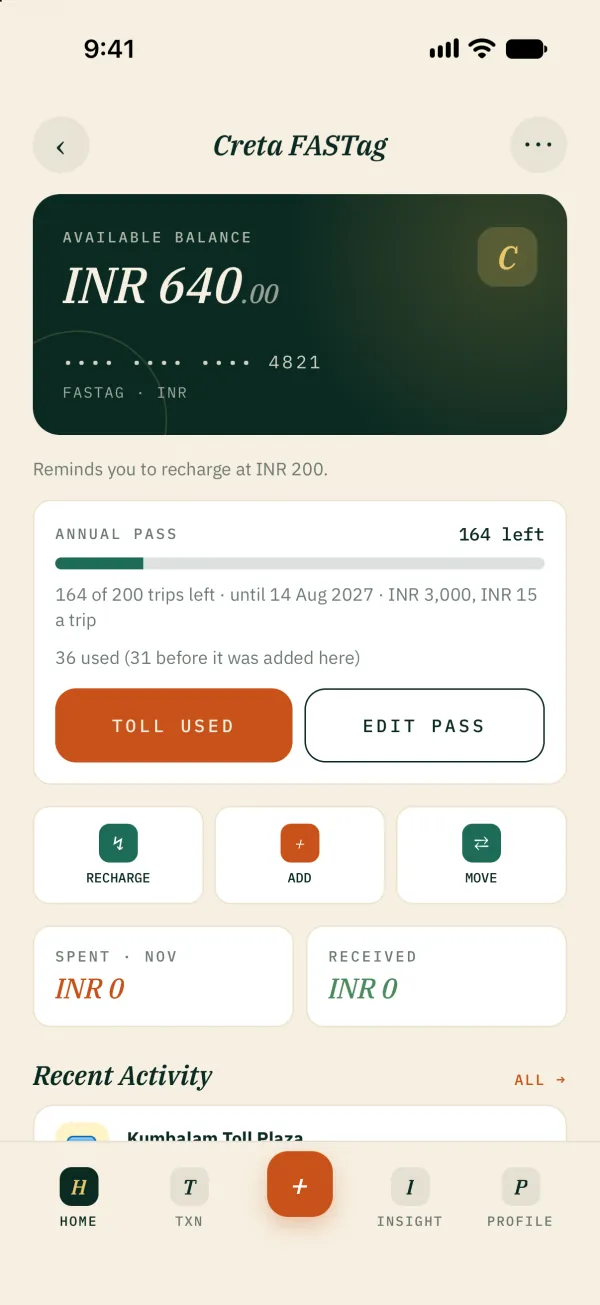
Log each fill for the car or the bike, a full tank or INR 500 at a time, and Monidhi works out the mileage it really gives, what a kilometre costs and how the price has moved. The FASTag sits beside it, with its recharge reminder and annual pass.

  • Mileage you can trustFull tank to full tank, or reserve to reserve for a bike you fill INR 500 at a time: tap Hit reserve when the bike goes on reserve, or note it with the fill. Overall, over the last 10,000 km and the last 1,000 km, each with how confident the figure is and a word when a fill looks missing.
  • What a kilometre costsFuel cost per km at pump prices, and the price you paid in your home state across the year. Fills in another state or of premium fuel are marked, since prices differ.
  • Any vehicle you driveYours, rented or the office car: a vehicle you don't own never touches your net worth, and a rental's rent comes up under Upcoming. The advance you paid its owner is kept in Lend & Borrow, and can pay the last rents. Bring an old fuel log and the fills already in your journal are matched, not doubled.
  • FASTag and the annual passA FASTag reminds you to recharge before it runs low, and the annual pass counts down its trips from the toll messages, kept in step with the count your bank sends.
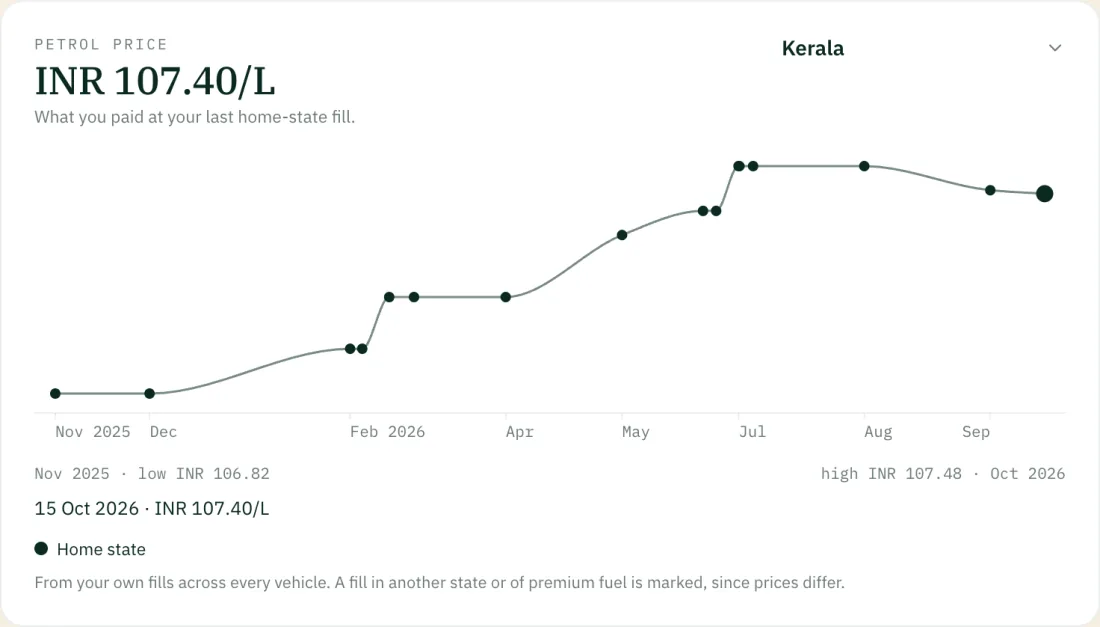
The petrol price paid in Kerala from November 2025 to October 2026, from INR 106.82 to INR 107.48 a litre.
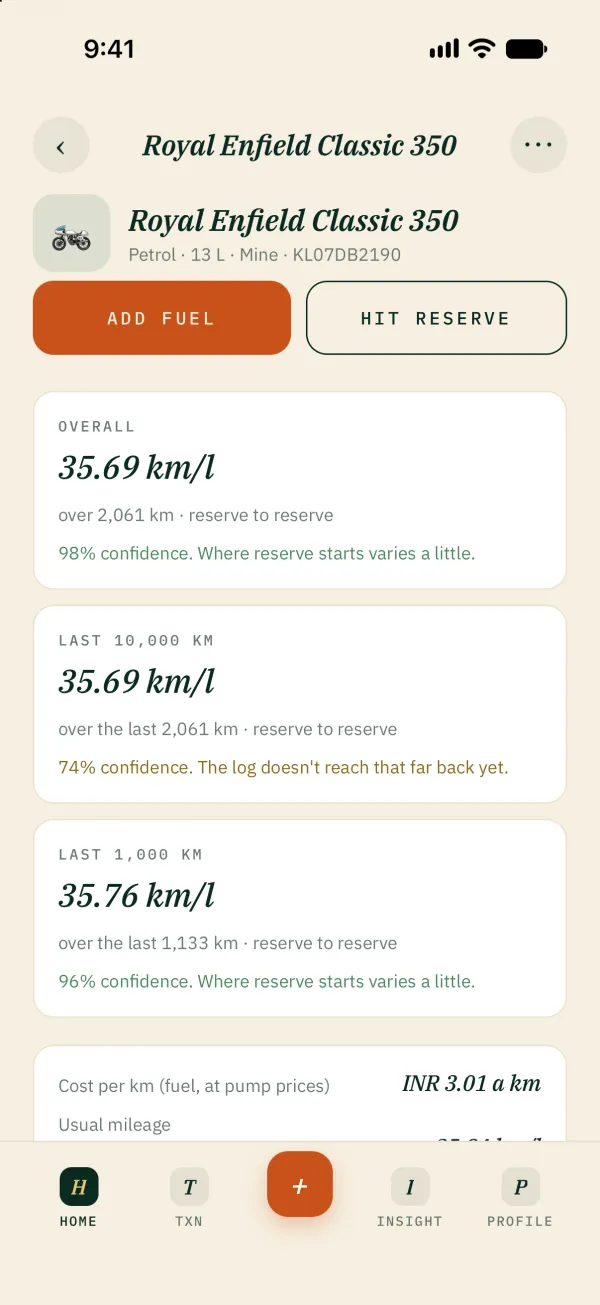
A Royal Enfield Classic 350 on iPhone, logged reserve to reserve: 35.69 km a litre over 2,061 km at 98% confidence, and 35.76 over the last 1,133 km.
Investments

Investments, at what they're worth.

Mutual funds, stocks, NPS, PPF, EPF, gold and silver sit next to your bank accounts, valued for you each day, read from your statements, or typed by hand. Monidhi keeps what you put in apart from what it's worth today, so your returns are always one glance away.

  • Invested vs worthSIPs and top-ups count as money put in, kept apart from what the holding is worth, so the return is always there.
  • Valued every day, no broker loginFunds take the day's NAV from AMFI, NPS its scheme NAVs from NPS Trust, shares and crypto their market price, gold and silver their rate per gram, FDs and PPF their interest. Each automatic value shows how confident it is, and a figure you type for the day is kept over it.
  • Statements set the unitsForward your CAS or demat statement and each folio's units are set for you. Every value is kept, automatic, typed or from a statement, so you can see how a fund moved month to month.
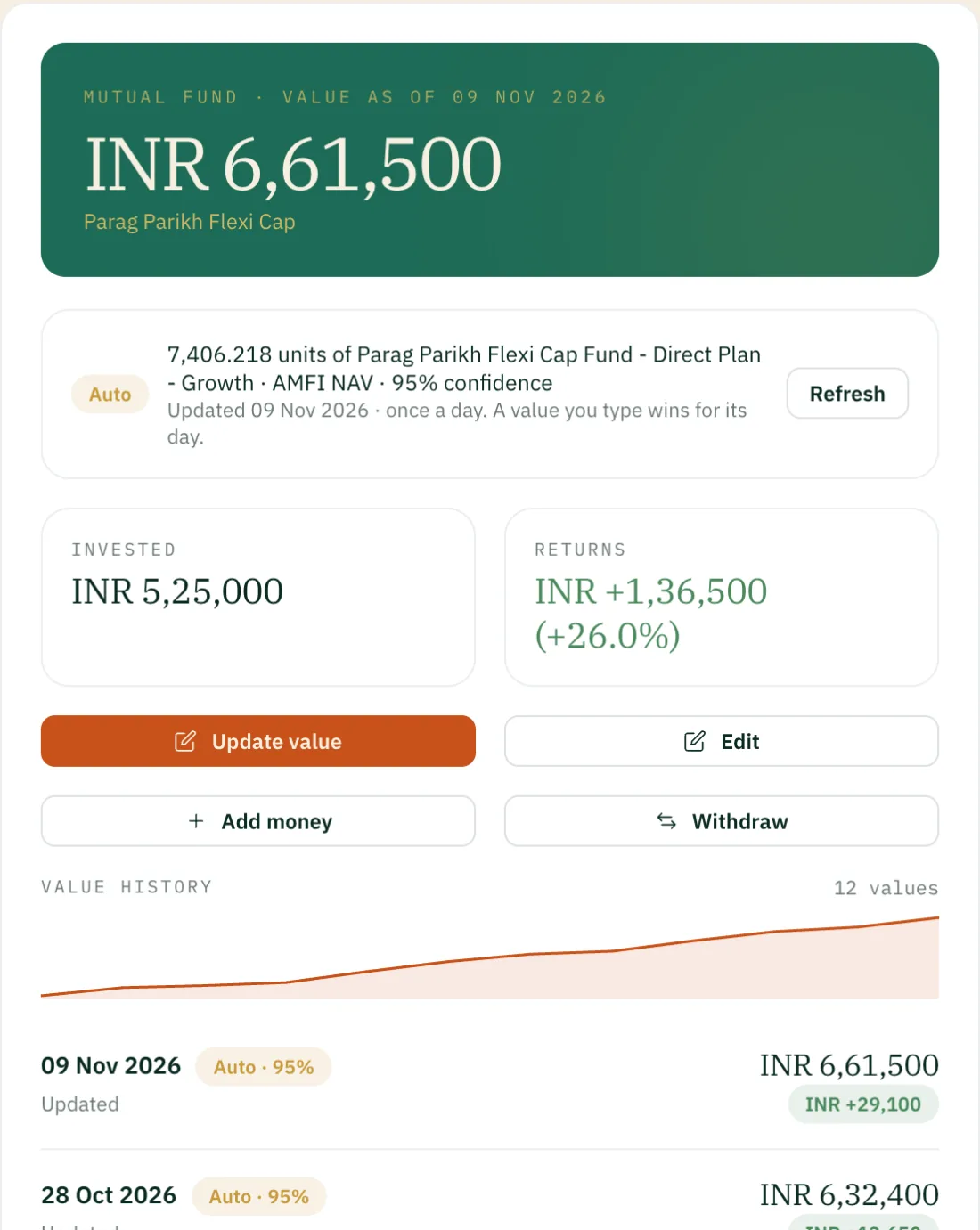
A mutual fund valued from AMFI's NAV at 95% confidence: INR 6,61,500 against INR 5,25,000 invested, a 26% return, and its value history.
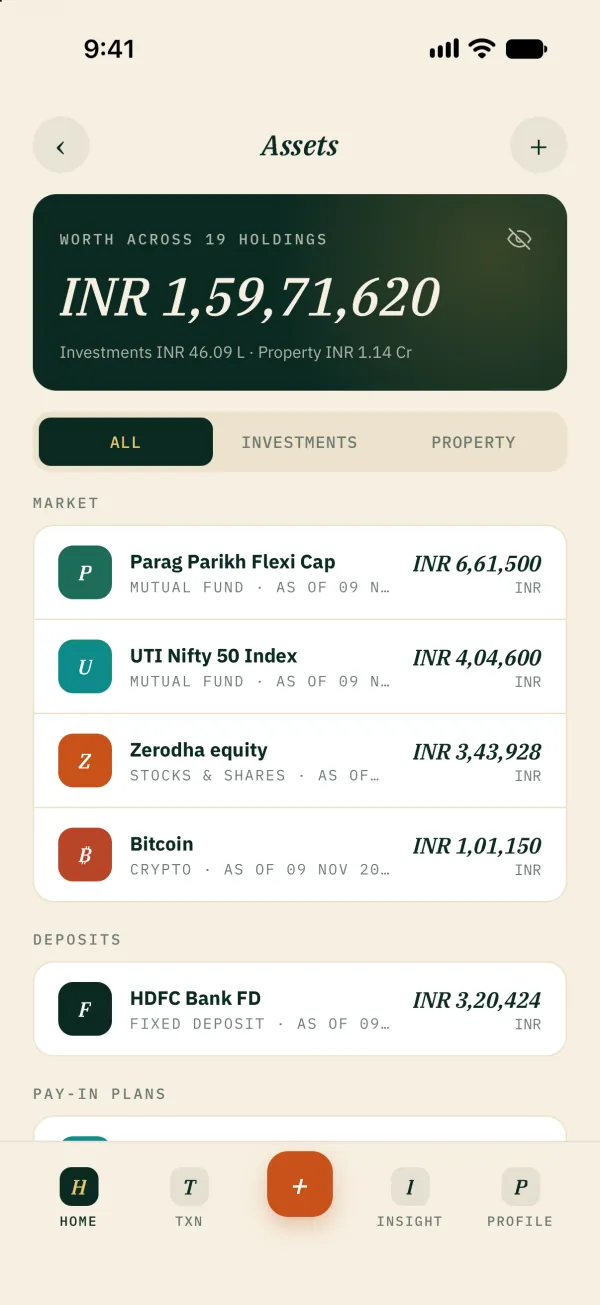
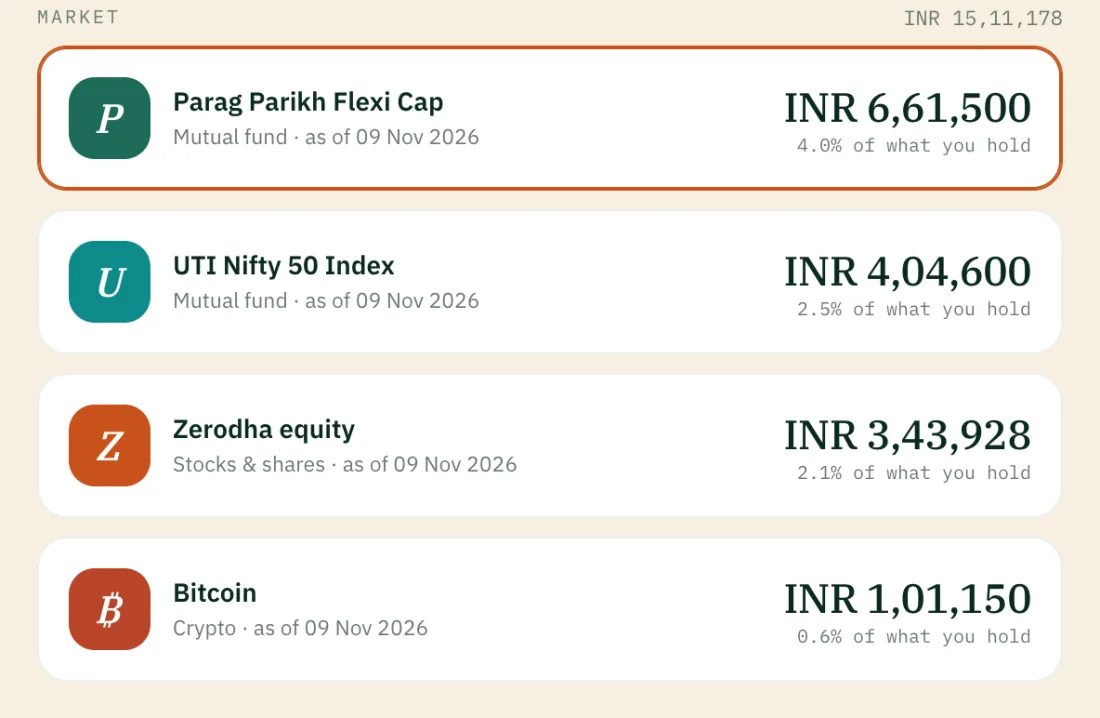
Market investments: two mutual funds, shares and Bitcoin, each valued today.
New · Chit funds & insurance

The chitty, the policy, the post office too.

Not every rupee you save sits in a bank or a fund. Add a chit fund, a jeweller's gold scheme, a health or endowment policy, a PPF or Sukanya Samriddhi account, or the deposit your landlord holds. Each keeps its own terms and its own buttons: Pay instalment, Record bid / prize, Pay premium, Interest received, Record refund.

  • Chit funds, the way they runEach instalment comes up under Upcoming, and you type what you paid, since the dividend changes it. Record the bid when you win: the money lands in your bank, and the instalments still to pay count in what you owe until the last one.
  • Cover that renewsHealth, vehicle, term, home and travel cover keeps its insurer, sum insured and renewal day. Each premium is booked as an expense under the category you pick and remembered for the next renewal, with a reminder a month before.
  • Small savings and depositsPPF, SSY, NSC, KVP, SCSS and post office schemes grow at their rate, and interest paid out is booked as income. A rent deposit counts in your net worth until it comes back, with anything kept back booked as an expense.
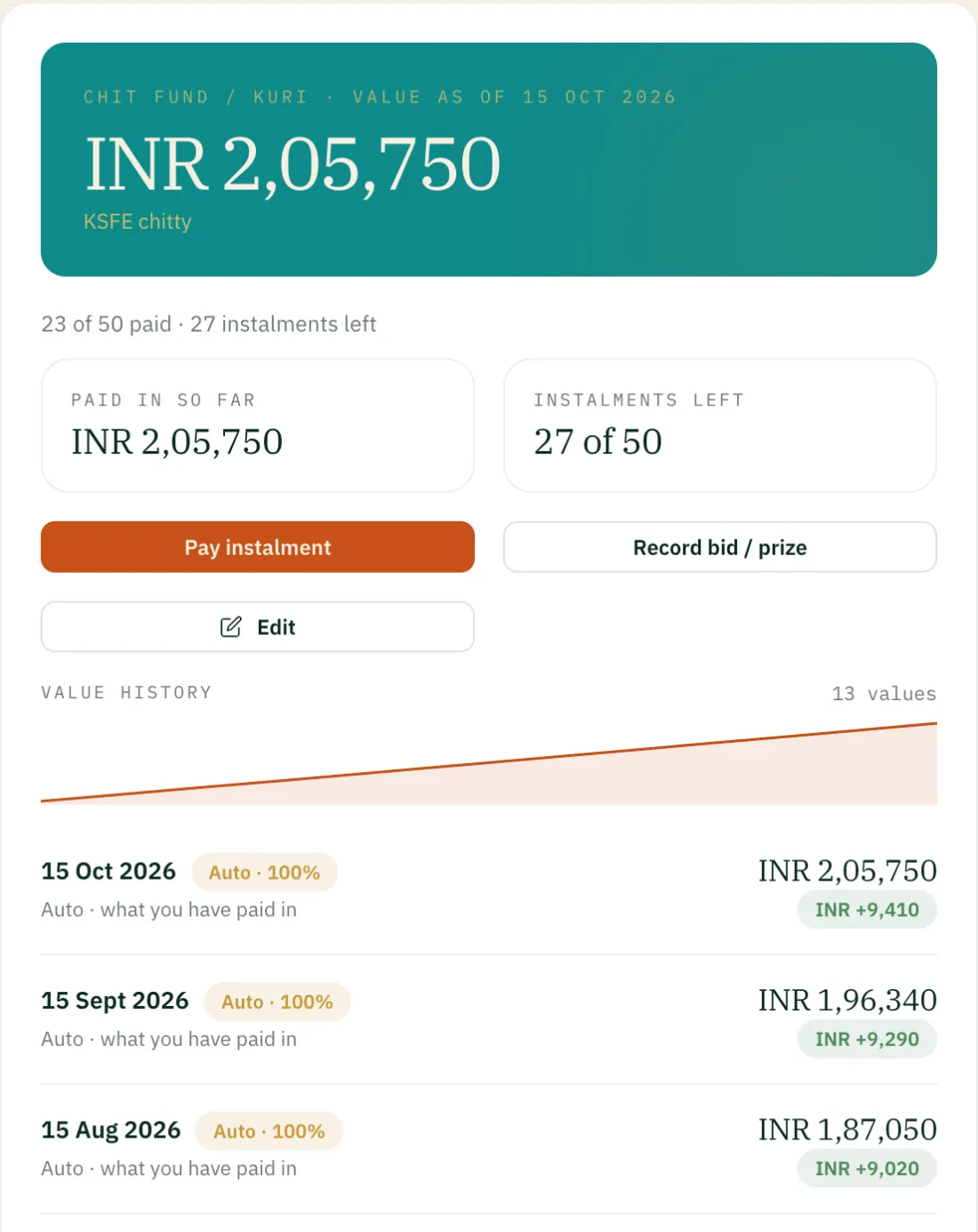
A KSFE chit fund worth the INR 2,05,750 paid into it: 23 of 50 instalments paid, 27 left, with Pay instalment, Record bid / prize, and its value after each month's instalment.
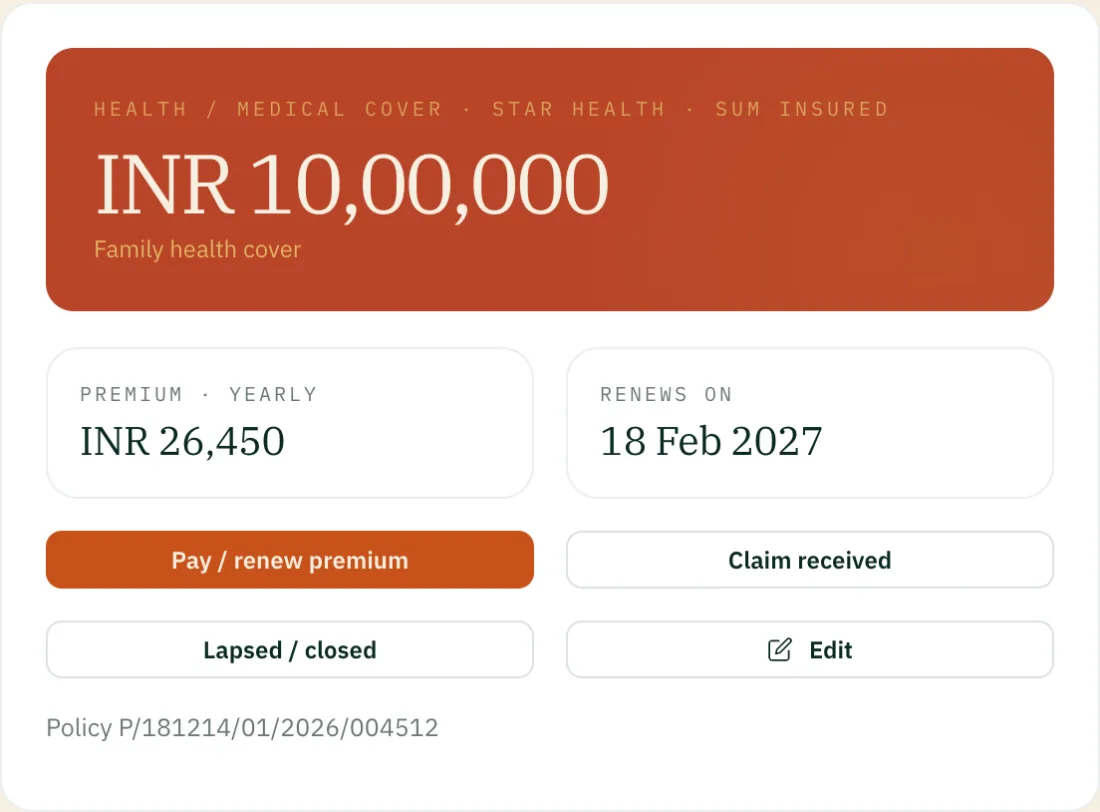
Family health cover from Star Health: INR 10,00,000 sum insured, a INR 26,450 yearly premium that renews on 18 Feb 2027, and Pay / renew premium, Claim received and Lapsed / closed.
Assets

The things you own, counted.

Your flat, your car, the family gold. Give each one a value, or let Monidhi estimate it, and it's folded into your net worth with a record of how that value changed.

  • Homes, land, cars, jewelleryAnything you own that's worth counting, each with the date of its last value.
  • Bought for vs worth nowRecord what you paid and let Monidhi estimate the rest: a car by the insurer's depreciation table, jewellery by weight at today's gold rate, a flat at the yearly growth you expect. Type a better figure whenever you have one. Gains show — and so does what the car has lost.
  • Kept out of your spendingA new value changes your net worth, never this month's spending. Sell it and the money comes in as a transfer, not income, with costs like a broker's commission as spending. From the day of the sale it's worth nothing.
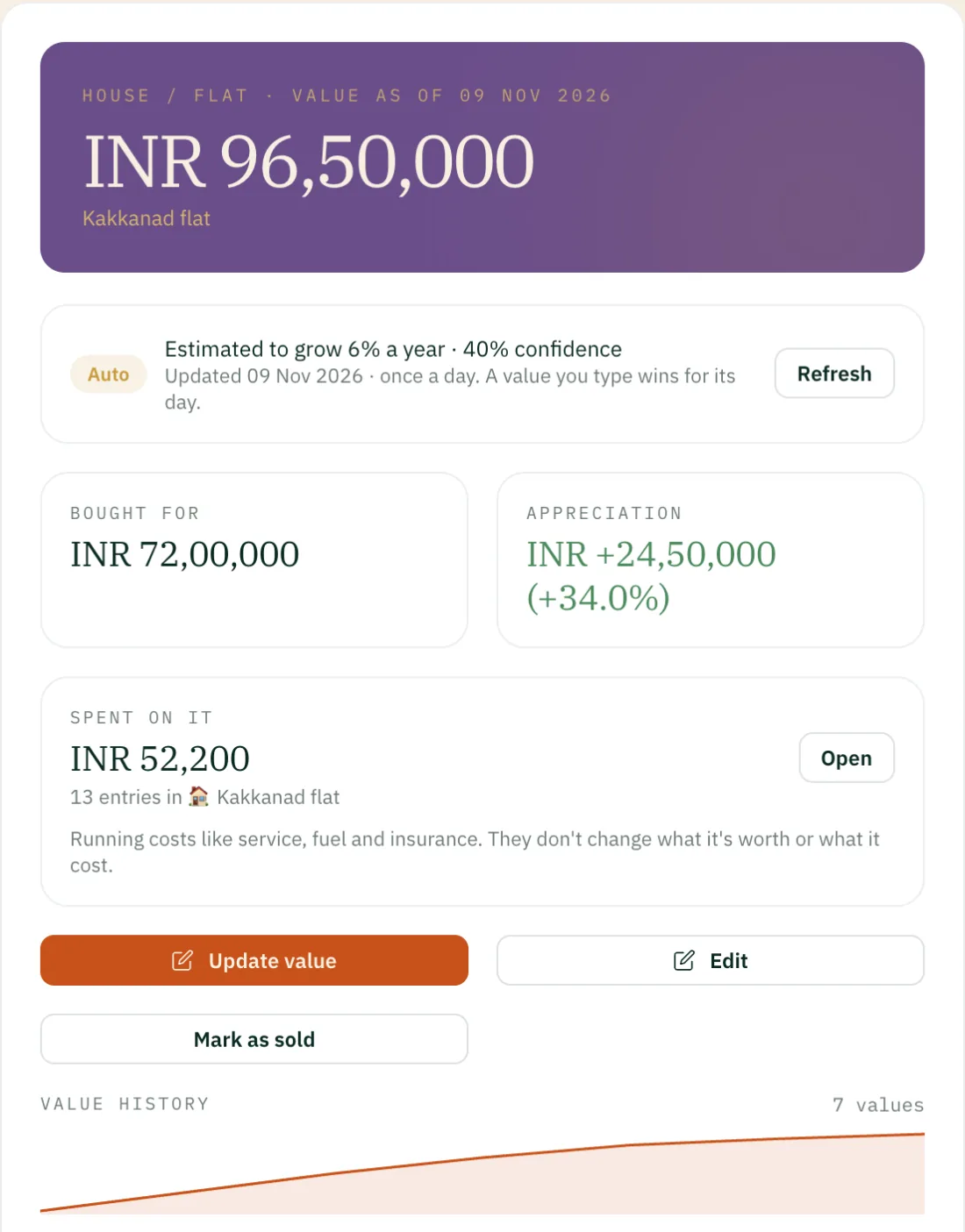
A flat bought for INR 72 lakh, estimated at INR 96.5 lakh by 6% yearly growth, with values typed by hand and worked out automatically.
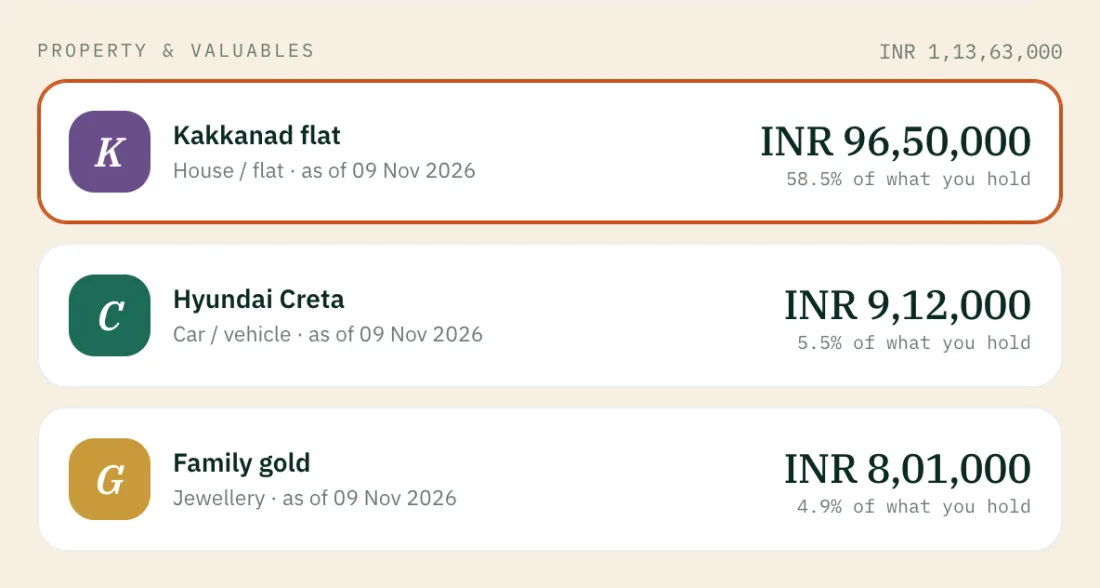
Property & valuables: a flat, a car and family gold, each valued today.
Vichāra · विचार

The pause before the purchase.

Type an amount. Monidhi tells you exactly what it costs — in net worth, in savings rate, and in months of goals you'd push back.

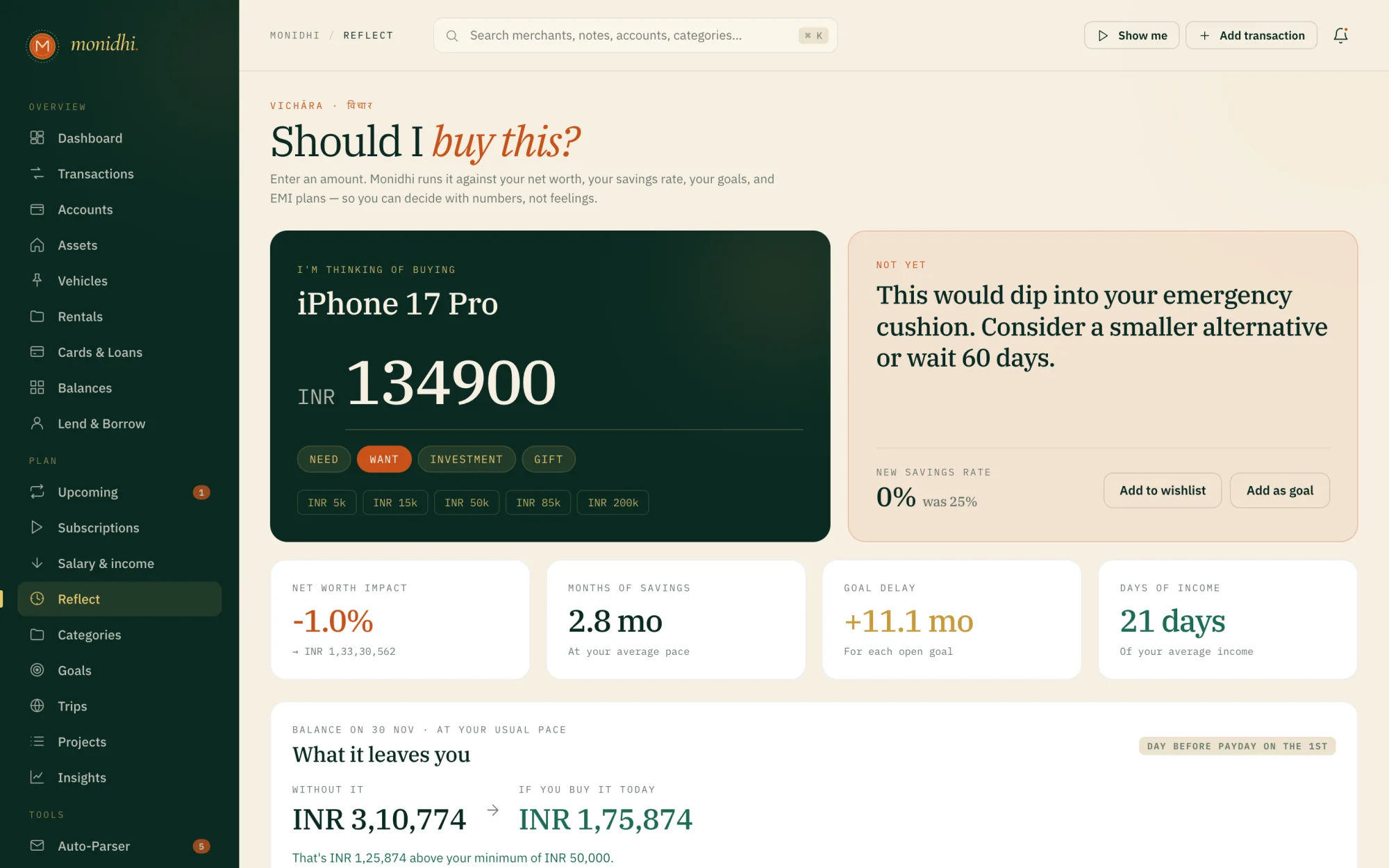
Reflect weighing a INR 1,34,900 phone against net worth, months of savings, goal delay and days of income, and what it leaves before payday.
Why we built this

Money should be a private conversation.

The apps we tried wanted to know everything — every account, every login, every habit. Monidhi works the opposite way. It reads your bank messages, keeps only what it needs to file them, and never sells what it knows.

"The only finance app that actually shows me how every recurring bill and casual swipe nudges my net worth — month after month."

Ross · Kochi · Beta tester

3-minute setup · No card required

Start your kosh.

A treasure-keeper for your money — and yours alone.